Overview
This article describes how to configure a Logic App that Turbo360 triggers after it has taken an action on an individual resource — such as turning a VM on or off, or scaling it up or down. Unlike the after-schedule hook (which fires once per schedule run), this hook fires once per resource after each individual resource action completes. Use this hook to run resource-specific follow-up logic, such as executing a PowerShell script on the VM after it has been started.
Business value
Per-resource post-action hooks let you react to the new state of each individual resource after the schedule acts on it. You can use the Azure resource ID passed in the request to call the Azure Management API targeting that specific resource — for example, writing a startup confirmation to the Windows Event Log, triggering a warm-up script, or notifying a dependent service that the resource is now running.
Prerequisites
Before configuring this hook, ensure the following are in place:
- A schedule is configured in Cost Analyzer with at least one resource.
- You have access to create and deploy a Logic App (Consumption) in Azure.
- The Logic App endpoint is accessible from Turbo360 (no firewall blocking outbound webhook calls).
- If the Logic App calls the Azure Management API (for example, to run commands on the VM), a User Assigned Managed Identity with the appropriate RBAC role must be configured on the Logic App.
Required permissions
You must have the Contributor or Owner role on the Azure subscription to create the Logic App and configure managed identity. Within Turbo360, you must have Manage access on the Cost Analyzer schedule to configure the after-resource action. If you call the Azure Management API using Run Command, the managed identity also requires the Virtual Machine Contributor role on the target VMs or resource group.
How it works
When a schedule is configured with an after-resource action, Turbo360 calls the configured Logic App endpoint via HTTP immediately after acting on each resource in the schedule. The request includes the standard schedule headers — execution type and schedule operation — plus an AzureResourceId header identifying the specific Azure resource that was just actioned.
Your Logic App can use the resource ID to make targeted calls to the Azure Management API, such as running a PowerShell script on the VM using the Run Command operation. Because the resource action has already completed by the time this hook fires, a Logic App error or timeout does not affect whether the resource was started or stopped.
Steps
Use the following steps to set up and validate an after-resource Logic App hook. Start in Cost Analyzer > Schedule Automation and open the schedule you want to extend.
Create the after-resource action
Configuring the action on the resource registers the Logic App endpoint that Turbo360 will call after acting on that resource.
- Open the target schedule in Cost Analyzer > Schedule Automation.
- Locate the resource you want to configure within the schedule's resource list.
- Open the resource's action settings and select After resource action.
- Enter the Logic App HTTP trigger URL.
- Save the schedule.
- Use the Validate button to send a test event to the Logic App before the schedule next runs live.
Handle the HTTP headers
The scheduler passes the following HTTP headers to your Logic App on every trigger — use them to control your workflow logic.
| Header | Use | Values |
|---|---|---|
Execution-Type | Indicates whether this is a test event from the Validate button or a live schedule run. | Test — the Validate button was clickedActual — the schedule ran live |
Schedule-Operation | Indicates the state the schedule moved this resource to. | Start — resource moved to the started (green) stateStop — resource moved to the stopped (red) state |
AzureResourceId | The full Azure resource ID of the resource the schedule just actioned. Use this to make targeted Azure Management API calls. | Azure resource ID string (e.g. /subscriptions/{id}/resourceGroups/{rg}/providers/Microsoft.Compute/virtualMachines/{vmName}) |
In your Logic App, implement the following conditional logic:
- If
Execution-Typeis Test, return an HTTP 200 acknowledgement and terminate — do not perform real actions. - If
Schedule-Operationis Start, perform your post-start resource actions (for example, run a startup script or log that the VM is now running). - If
Schedule-Operationis Stop, perform your post-stop resource actions.
Example scenario
A team wants to confirm in the Windows Application Event Log when each VM is started by the scheduler. They configure an after-resource Logic App hook that uses the AzureResourceId header to call the Azure Management API's Run Command operation, executing a PowerShell script that writes event ID 3002 to the Application log with source Turbo360-FinOps and the message "Turbo360 scheduler has just started this VM". This provides a timestamped audit trail directly in the VM's own event log for every scheduler-initiated start.
Logic App example
The screenshot below shows a sample Logic App workflow that handles the after-resource extensibility scenario, including the Run Command call to the Azure Management API on start.
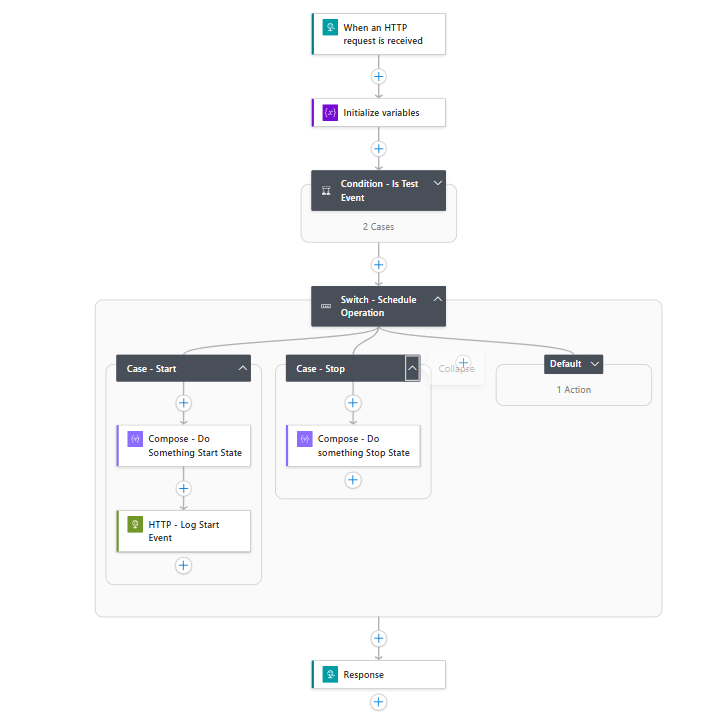
Sample Logic App template
Paste the following JSON into a Logic App Consumption workflow to get started quickly. Replace the managed identity resource path with your own, and update the PowerShell script to suit your post-start requirements.
{
    "definition": {
        "$schema": "https://schema.management.azure.com/providers/Microsoft.Logic/schemas/2016-06-01/workflowdefinition.json#",
        "contentVersion": "1.0.0.0",
        "triggers": { "When_an_HTTP_request_is_received": { "type": "Request", "kind": "Http" } },
        "actions": {
            "Response": { "type": "Response", "kind": "Http", "inputs": { "statusCode": 200 }, "runAfter": { "Switch_-_Schedule_Operation": ["Succeeded"] } },
            "Initialize_variables": {
                "type": "InitializeVariable",
                "inputs": {
                    "variables": [
                        { "name": "executionType", "type": "string", "value": "@{triggerOutputs()?['headers']?['Execution-Type']}" },
                        { "name": "scheduleOperation", "type": "string", "value": "@{triggerOutputs()?['headers']?['Schedule-Operation']}" },
                        { "name": "resourceId", "type": "string", "value": "@{triggerOutputs()?['headers']?['AzureResourceId']}" }
                    ]
                },
                "runAfter": {}
            },
            "Condition_-_Is_Test_Event": {
                "type": "If",
                "expression": { "and": [{ "equals": ["@variables('executionType')", "Test"] }] },
                "actions": {
                    "Response_-_Ack_-_Test": { "type": "Response", "kind": "Http", "inputs": { "statusCode": 200 } },
                    "Terminate_-_Ack": { "type": "Terminate", "inputs": { "runStatus": "Succeeded" }, "runAfter": { "Response_-_Ack_-_Test": ["Succeeded"] } }
                },
                "else": { "actions": {} },
                "runAfter": { "Initialize_variables": ["Succeeded"] }
            },
            "Switch_-_Schedule_Operation": {
                "type": "Switch",
                "expression": "@variables('scheduleOperation')",
                "default": { "actions": { "Compose_-_Do_nothing": { "type": "Compose", "inputs": "You would do nothing here because the schedule is not going to the start or stop state" } } },
                "cases": {
                    "Case_-_Start": {
                        "actions": {
                            "Compose_-_Do_Something_Start_State": { "type": "Compose", "inputs": "The schedule has run to move the resources to the start state. Do something here AFTER the resources are acted upon" },
                            "HTTP_-_Log_Start_Event": {
                                "type": "Http",
                                "inputs": {
                                    "uri": "https://management.azure.com/@{variables('resourceId')}/runCommand?api-version=2025-04-01",
                                    "method": "POST",
                                    "headers": { "Content-Type": "application/json" },
                                    "body": {
                                        "commandId": "RunPowerShellScript",
                                        "script": [
                                            "$logName = 'Application'",
                                            "$source  = 'Turbo360-FinOps'",
                                            "$eventId = 3002",
                                            "$message = 'Turbo360 scheduler has just started this VM'",
                                            "",
                                            "if (-not [System.Diagnostics.EventLog]::SourceExists($source)) {",
                                            "  New-EventLog -LogName $logName -Source $source",
                                            "}",
                                            "",
                                            "Write-EventLog -LogName $logName -Source $source -EventId $eventId -EntryType Information -Message $message"
                                        ]
                                    },
                                    "authentication": {
                                        "type": "ManagedServiceIdentity",
                                        "identity": "/subscriptions/{your subscription id here}/resourceGroups/T360-Scheduler-VM-Demo-Actions/providers/Microsoft.ManagedIdentity/userAssignedIdentities/T360-Scheduler-VM-Demo-Actions",
                                        "audience": "https://management.azure.com/"
                                    },
                                    "retryPolicy": { "type": "none" }
                                },
                                "runAfter": { "Compose_-_Do_Something_Start_State": ["Succeeded"] }
                            }
                        },
                        "case": "Start"
                    },
                    "Case_-_Stop": { "actions": { "Compose_-_Do_something_Stop_State": { "type": "Compose", "inputs": "The schedule has run to the stopped state. You can do something here AFTER the schedule is actioned" } }, "case": "Stop" }
                },
                "runAfter": { "Condition_-_Is_Test_Event": ["Succeeded"] }
            }
        },
        "outputs": {},
        "parameters": { "$connections": { "type": "Object", "defaultValue": {} } }
    },
    "parameters": { "$connections": { "type": "Object", "value": {} } }
}
Troubleshooting
- The Logic App is not triggered after the resource action.
Cause: The after-resource action URL may not be saved correctly on the resource, or the Logic App HTTP trigger endpoint has changed.
Fix: Re-open the resource action settings in the schedule, verify the endpoint URL, and use the Validate button to confirm the trigger fires. - The Run Command call fails with a 403 Forbidden error.
Cause: The managed identity does not have the required RBAC role on the target resource or resource group.
Fix: Assign the Virtual Machine Contributor role (or a custom role withMicrosoft.Compute/virtualMachines/runCommand/action) to the Logic App's managed identity on the target resource group. - The Run Command call succeeds but no event log entry appears on the VM.
Cause: The VM may still be starting when the Run Command is called, meaning the OS is not yet ready to accept commands.
Fix: Add a delay action before the Run Command step to allow the VM to fully initialize before executing PowerShell. - Test events trigger real Azure API calls.
Cause: The Logic App is not checking theExecution-Typeheader before executing the Run Command action.
Fix: Ensure the Is Test Event condition is positioned before the Switch action and terminates with HTTP 200 whenExecution-TypeisTest. - The
AzureResourceIdheader is empty in the Logic App run.
Cause: The header variable expression may be malformed.
Fix: Verify the expression@{triggerOutputs()?['headers']?['AzureResourceId']}is correctly set in the Initialize variables action and that the action name matches the reference in subsequent steps.