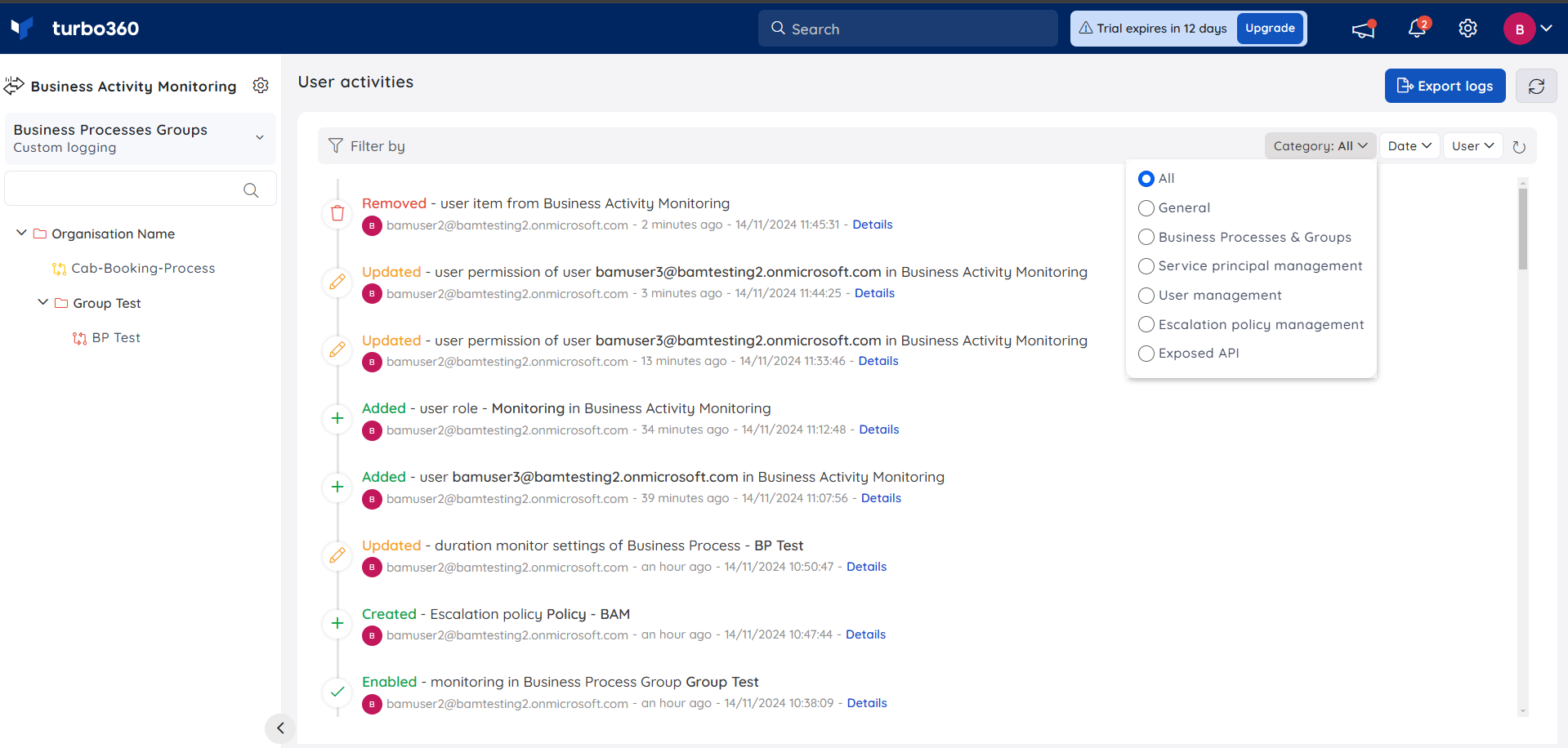

BAM user activities

Prev Next

Overview

User activities in Business Activity Monitoring (BAM) records every management action taken by users across the module. You can view these logs to track who changed what and when — from module-level configuration down to individual Business Process operations.

User activities are available in both the Custom Logging (Push Model) and Data Queries (Pull Model) types. The same audit log UI is used for both models. Some logged operations are specific to one model and are noted where they apply.

Business value

A complete audit trail of user actions supports governance and compliance requirements and simplifies incident investigation. When something changes unexpectedly — a transaction is deleted, a monitoring rule is updated, or a user's permissions are modified — you can identify the responsible action and actor without manual investigation.

How it works

User activities logs are organized into three categories, each corresponding to a management domain in Business Activity Monitoring:

  • General — module-level actions such as importing a Business Process and managing global properties (Push Model) or service principals (Pull Model)
  • Business Process — all actions performed on Business Process groups, Business Processes, transactions, queries, and dashboards
  • User management — all user access and role changes

You can view activity logs at two scopes: at the module level (covering all Business Processes) or at the individual Business Process or Business Process group level.

To access the module-level activity log:
Navigate to Business Activity Monitoring > User activities from the module settings.

To access the activity log for an individual Business Process or group:
Click the Context menu ( ⋮ ) next to the desired Business Process or Business Process group in the tree view and select User activities.

Note:

Access to User activities depends on your role and scope:

  • Module-level User activities is available to Account Owner, Owner, and Contributor roles only. Users with user-defined roles cannot access it.
  • Business Process-level and Business Process group-level User activities is accessible to users with user-defined roles, scoped to the Business Processes or groups within their assigned access.
  • Users with Specified access can only view User activities for the Business Processes within their assigned scope.

General

The General category records all actions performed at the module level of Business Activity Monitoring. Logged operations differ by model:

Push Model (Custom Logging):

  • Importing a Business Process
  • Custom connector deployment
  • Creating, updating, or deleting a global property

Pull Model (Data Queries):

  • Importing a Business Process
  • Adding, updating, or removing a service principal

Business Process

The Business Process category records all actions performed on Business Process groups, Business Processes, transactions, queries, and dashboards. The following operations are logged:

Area Logged operations Model
Business Process groups Creating, updating, deleting a Business Process group Both
Business Processes Creating, updating, deleting a Business Process; enabling or disabling monitoring Both
Business Processes Enabling or disabling tracking Push Model only
Monitoring Updating monitoring rules and configuration Both
Transactions Adding, updating, deleting, or importing a transaction; updating transaction flow Both
Transactions Cloning or deleting a cloned transaction Push Model only
Queries Query management; importing a query Both
Dashboards Dashboard management; importing a dashboard Both

User management

The User management category records all user access and role changes. The following operations are logged:

  • Adding a new user or group
  • Updating user permissions
  • Removing an existing user or group
  • Adding a new role
  • Updating an existing role
  • Deleting a role

Troubleshooting

  1. The User activities option is not visible in the module navigation.
    Cause: Module-level User activities is only available to Account Owner, Owner, and Contributor roles. Users with user-defined roles do not have access to this view.
    Fix: Verify the user's role in Business Activity Monitoring > User management. If module-level audit access is required, the user must be assigned the Owner or Contributor role, or the Account Owner must review their role assignment.

  2. A Business Process's User activities option is missing from the context menu.
    Cause: The user does not have any assigned access (direct or specified) to that Business Process, or the Business Process is outside their assigned scope.
    Fix: Confirm the user's scope in the User management section. Ensure the Business Process is included in their specified access assignment.

  3. A known action is not appearing in the activity log.
    Cause: Only the operations listed per category are tracked. Actions performed outside Business Activity Monitoring (for example, changes made directly in Azure) are not recorded in BAM user activities. Additionally, some operations are model-specific — a Push Model action will not appear in a Pull Model log and vice versa.
    Fix: Check whether the action falls within a tracked operation category for the relevant model. For platform-level or Azure-side changes, consult the relevant Azure audit log.

  4. Activity logs show entries attributed to an unexpected user.
    Cause: A Microsoft Entra ID group was used to grant access, and the group's permissions were evaluated rather than individual member permissions. The acting user's identity may appear as the group.
    Fix: Review the group's role assignment in User management and cross-reference with Microsoft Entra ID group membership to identify the individual who performed the action.

  5. User management log entries are missing for a role change that was made.
    Cause: The log may take a short time to reflect recent changes, or the change was performed at a scope not visible under the current view.
    Fix: Refresh the User activities page. If the entry is still missing, check whether the action was performed at a different scope (module level vs Business Process level) and switch views accordingly.

Related articles