Overview
The Turbo360 private instance is deployed into your own Azure subscription using the Turbo360 installer tool. The installer provisions the required Azure resources, configures authentication, and provides a sign-up link once deployment completes.
Business value
Deploying a private instance gives your organisation full control over data residency, network isolation, and infrastructure governance. All Turbo360 resources run within your Azure subscription, with no dependency on shared Turbo360 cloud infrastructure.
Prerequisites
Before you begin, ensure the following are in place:
- An active Azure subscription with sufficient quota to create Web Apps, Function Apps, a SQL database, and a Storage Account.
- The latest Turbo360 installer tool downloaded from the Turbo360 portal.
- A service principal with the required roles (see Required permissions below).
Required permissions
These permissions apply to both Connection string and Managed identity authentication modes. The service principal must be assigned at least one of the following roles:
- Owner
- User Access Administrator
- Role-Based Access Control (RBAC) Administrator
In addition, the service principal must have the Contributor role on the target resource group to perform resource deployments.
Dependencies
- Azure subscription with permissions to create resource groups and assign roles.
- If using Managed Identity authentication: a Virtual Machine and a user-assigned Managed Identity must be created in the subscription before deployment.
How it works
The Turbo360 installer provisions four Azure resources in your subscription during deployment:
- Web App
- Function App
- SQL database
- Storage Account
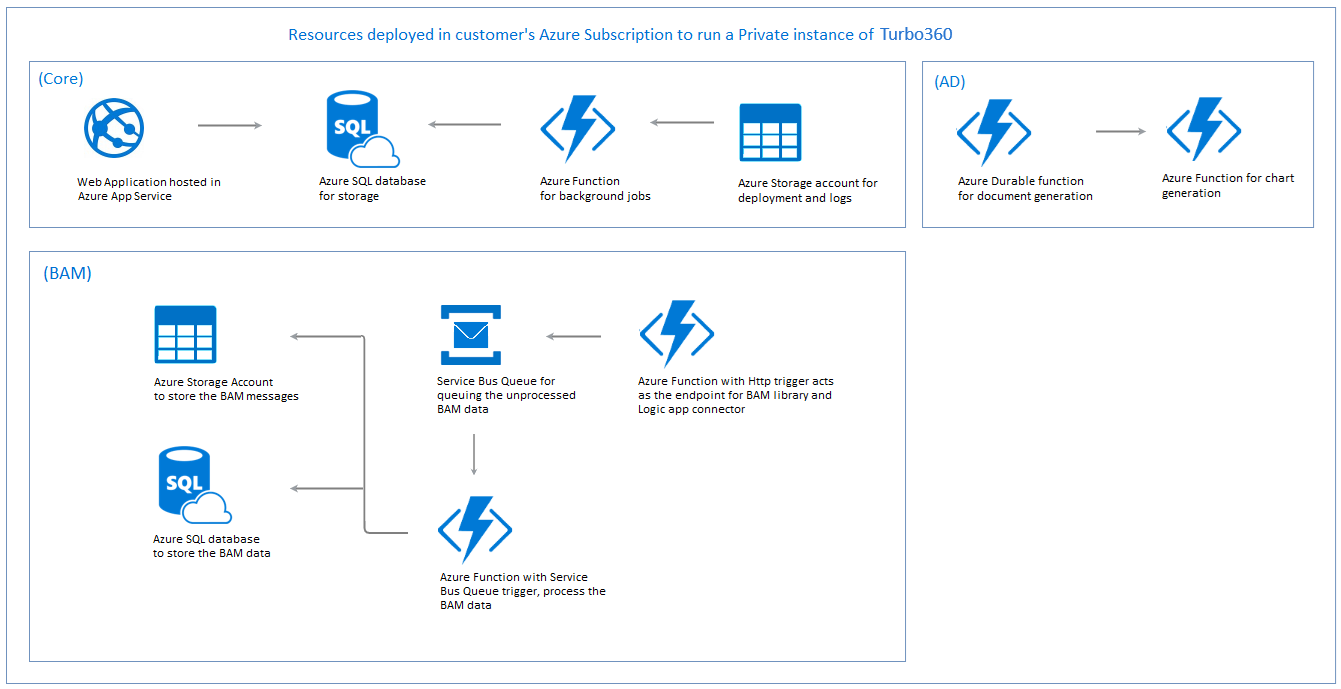
You select an Azure environment and an authentication mode, supply your service principal credentials or managed identity, configure resources, and then start deployment. The installer tracks progress step by step and provides a link to your private instance when complete.
Steps
Deploy using Connection string authentication
Connection string authentication uses service principal credentials to authenticate the installer against your Azure resources.
- Open the Turbo360 installer.
- Select the target Azure environment (see Azure environments below).
- Enter valid service principal details.
- Under Authentication, select Connection string.
- Configure resource names and regions.
- Click Start deployment.
Deploy using Managed Identity authentication
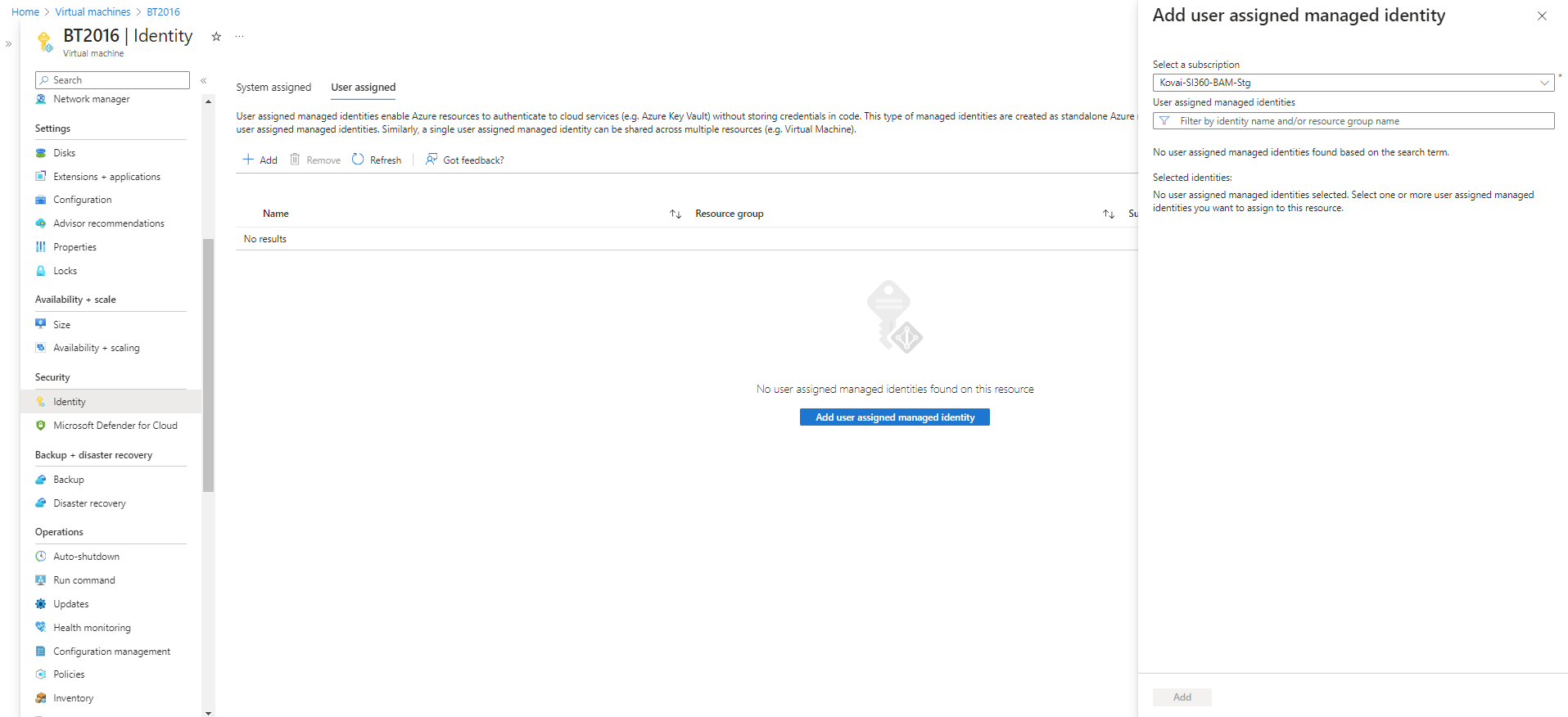
Managed Identity authentication avoids storing credentials by using an identity assigned to a Virtual Machine. Before running the installer, create a Managed Identity and assign it to a Virtual Machine:
- Create a Managed Identity and a Virtual Machine in any Azure subscription.
- In the Azure portal, open the Virtual Machine. Navigate to Security → Identity.
- Assign the Managed Identity to the Virtual Machine.
- Open the Turbo360 installer.
- Select the target Azure environment.
- Enter valid service principal details.
- Under Authentication, select Managed identity.
- Configure resource names and regions.
- Click Start deployment.
Monitor deployment status
The Deployment section of the installer shows the status of each provisioning step in real time.
Expect a deployment duration of approximately 10 minutes.
When deployment completes, the installer displays a hyperlink. Use this link to access your Turbo360 private instance and complete the sign-up process.
Configuration
Azure environments
The Turbo360 installer supports the following Azure environments:
| Environment | Description |
|---|---|
| Azure Global Cloud | Standard commercial Azure regions worldwide |
| Azure China Cloud | Azure operated by 21Vianet in China |
| Azure US Government | Azure regions for US government workloads |
Authentication modes
| Mode | Description |
|---|---|
| Connection string | Authenticates using service principal credentials and connection strings |
| Managed identity | Authenticates using a user-assigned Managed Identity attached to a Virtual Machine |
Resource deployment options
You can deploy resources in two ways:
- Create new resources — the installer creates all Azure resources in the region you specify.
- Use pre-existing resources — supply existing Azure resource names. For Managed Identity deployments using pre-existing resources, the user-assigned Managed Identity must already be associated with the Function Apps and Web App.
Permission behavior
With the required roles assigned: The installer can create resources, assign roles, and complete deployment without interruption.
Without the required roles: Deployment will fail during resource provisioning or role assignment steps. Assign at least one of Owner, User Access Administrator, or RBAC Administrator to the service principal, plus Contributor on the target resource group, then retry.
Example scenario
A platform engineer needs to deploy Turbo360 in the organisation's Azure subscription for data residency compliance. They create a service principal, assign it the Contributor and User Access Administrator roles on the target resource group, select Azure Global Cloud in the installer, choose Connection string authentication, and complete deployment in approximately 10 minutes. The engineer accesses the generated sign-up link to activate the private instance.
Limitations
- Deployment is supported only in Azure environments listed above (Global Cloud, China Cloud, US Government). Other sovereign cloud environments are not supported.
- Pre-existing resource deployments with Managed Identity require the user-assigned Managed Identity to be pre-associated with Function Apps and Web Apps.
- Deployment duration is approximately 10 minutes under normal conditions; network latency or resource quota constraints in the target region may extend this.
- Only one Turbo360 private instance can be deployed per resource group.
Troubleshooting
-
Deployment fails during role assignment
Cause: The service principal does not have a required IAM role.
Fix: Assign Owner, User Access Administrator, or RBAC Administrator to the service principal, plus Contributor on the target resource group, and retry the deployment. -
Managed Identity authentication fails
Cause: The Managed Identity has not been assigned to the Virtual Machine before running the installer.
Fix: In the Azure portal, navigate to the Virtual Machine → Security → Identity and assign the Managed Identity, then restart the installer. -
Installer cannot connect to the Azure environment
Cause: Incorrect Azure environment selected, or the service principal credentials are invalid.
Fix: Verify the Azure environment matches the subscription type. Re-enter valid service principal credentials (client ID, tenant ID, and client secret). -
Deployment stalls with no progress
Cause: Azure resource quota limits have been reached in the target region.
Fix: Check subscription quotas for Web Apps, Function Apps, SQL, and Storage in the Azure portal. Request a quota increase or choose a different region. -
Sign-up link not displayed after deployment
Cause: One or more deployment steps did not complete successfully.
Fix: Review the deployment status screen for failed steps. Resolve the indicated errors and re-run the installer.
FAQs
-
Can I redeploy to the same resource group if a previous deployment failed?
Yes. Re-run the installer and target the same resource group. Resources that were already created will be detected; the installer will attempt to complete the remaining steps. -
Which authentication mode should I use?
Use Connection string for straightforward deployments where service principal credentials are available. Use Managed identity when your security policy restricts credential-based authentication or when you need to align with Azure best practices for workload identity. -
Can I change the Azure environment after deployment?
No. The Azure environment is fixed at deployment time. To move to a different environment, you must deploy a new private instance in the target environment and migrate your data separately.