Overview
The Turbo360 private instance can be upgraded to the latest version using the Upgrade option in the Turbo360 installer tool. The upgrade process validates your existing resource connections, checks for available versions, and applies the update to your deployed Azure resources.
Business value
Keeping your private instance up to date ensures access to the latest Turbo360 features, security patches, and performance improvements, while maintaining compatibility with your Azure infrastructure.
Prerequisites
- The latest Turbo360 installer downloaded from the Turbo360 portal.
- Access to the Azure portal and the deployed Turbo360 private instance resources.
- Connection strings for the SQL database and Storage account, retrievable from the Web App in Azure.
Required permissions
The service principal or identity used must have the same permissions required for the original deployment: at least one of Owner, User Access Administrator, or RBAC Administrator, plus Contributor on the target resource group.
If upgrading a VNet-enabled instance, the upgrade must be run from a VM inside the virtual network, or public access on SQL and Storage must be temporarily re-enabled before starting.
Dependencies
- Turbo360 installer (latest version).
- Active Azure subscription with the deployed private instance resources.
- If BAM module is configured: the BAM Function Apps listed in the breaking changes section must also be updated where applicable.
How it works
The Upgrade option in the Turbo360 installer validates your current environment and applies updates in sequence:
- You provide the connection strings for your SQL database and Storage account, matching the authentication type used during original deployment.
- The installer validates the connections.
- You click Check for Updates to view the current installed version and the latest available version.
- Clicking the latest version number hyperlink displays the release notes for that version.
- You start the upgrade. The installer deploys updated resources to your Azure subscription.
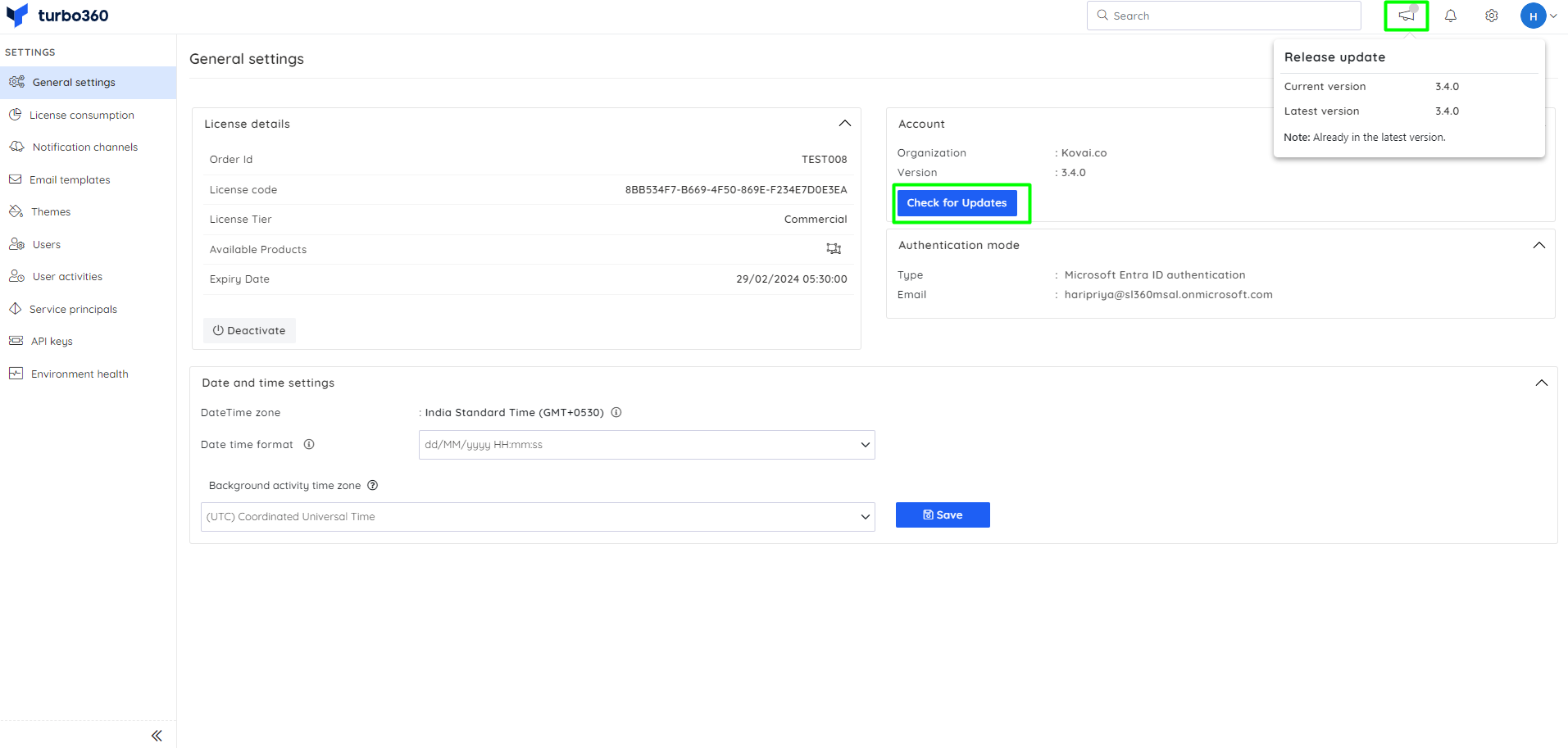
You can also check for updates directly from within the Turbo360 application under General Settings, or by using the Release update icon.
Steps
Use the following steps to upgrade a Turbo360 private instance or check for available updates. Open the Turbo360 installer to get started.
Run an upgrade
Running the upgrade applies the latest available version to your deployed Azure resources using the connection strings from your existing environment.
-
Download the latest Turbo360 installer from the Turbo360 portal.
-
Open the installer and select Upgrade.
-
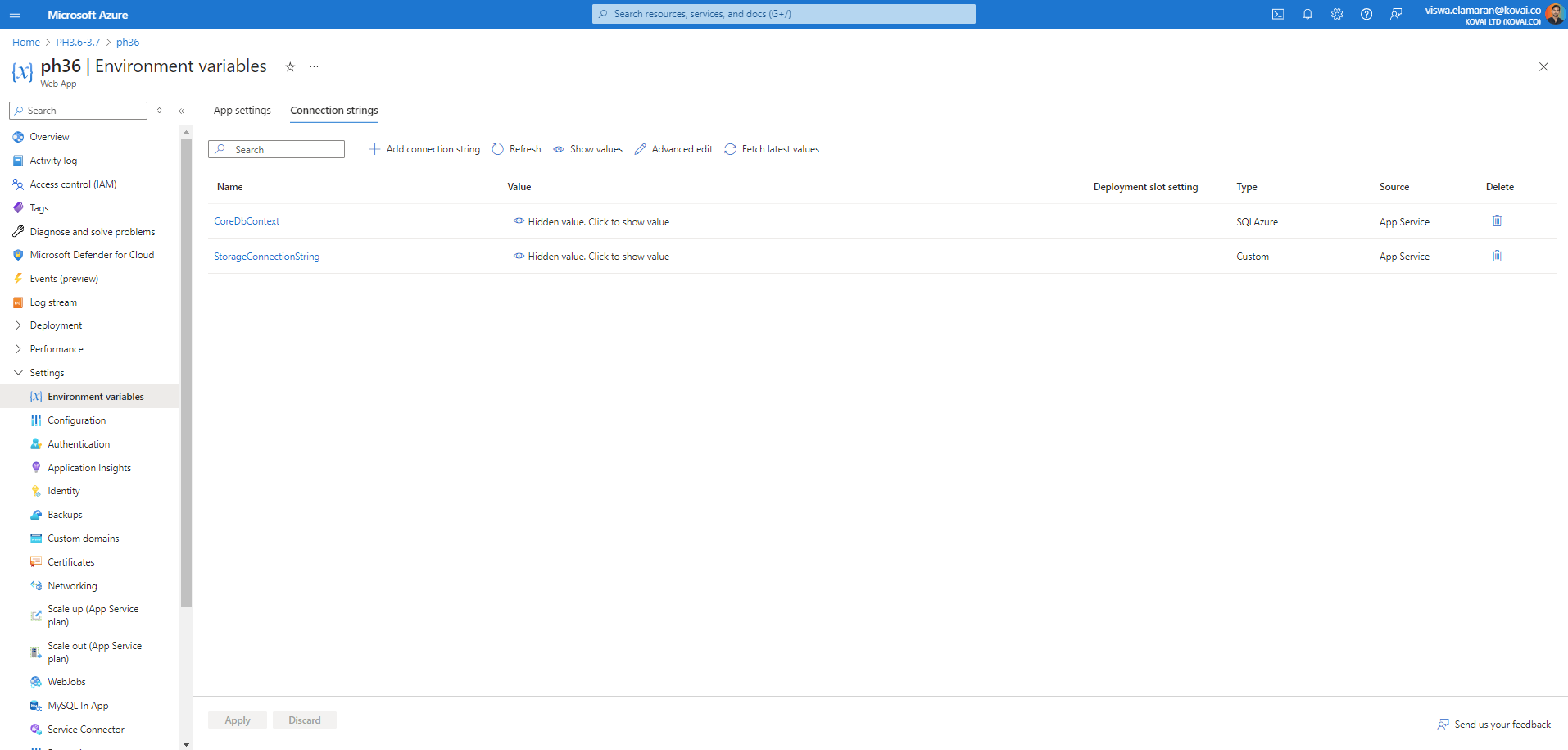
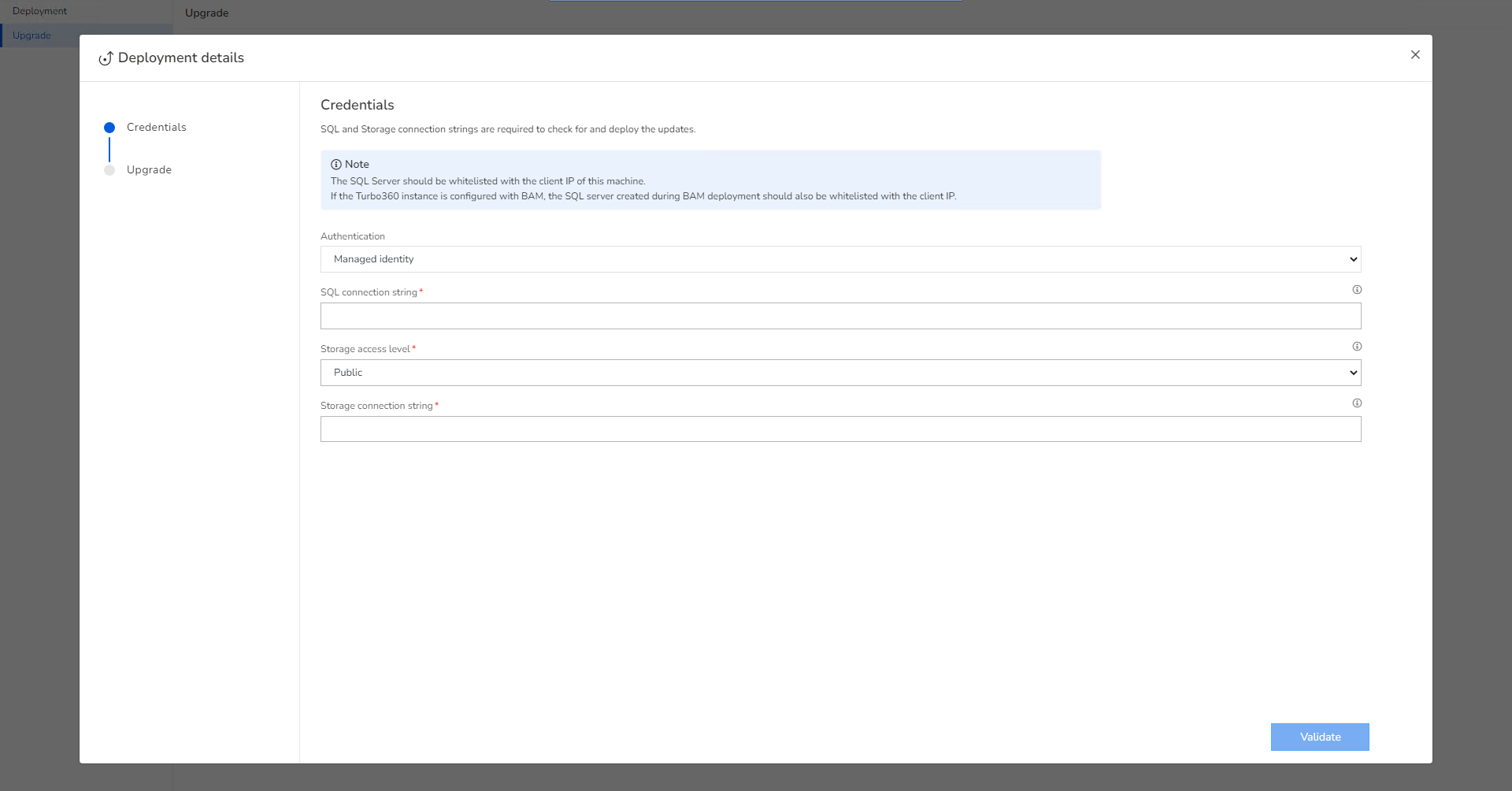
Enter the connection strings for your SQL database and Storage account.
Retrieve connection strings from the Azure portal: open the Web App for your private instance and navigate to Settings > Environment variables > Connection strings.
-
Click Validate to verify the connection strings.
-
Once validated, click Check for Updates to see the current version and the latest available version.
-
Click the latest version number hyperlink to review the release notes.
-
Start the upgrade.
Check for updates in-app
Checking for updates from within Turbo360 lets you confirm whether a newer version is available without opening the installer.
- Navigate to General Settings in the Turbo360 application, or
- Click the Release update icon.
Breaking changes by version
Review the breaking changes below before upgrading. Apply any required manual configuration steps for versions between your current version and the target version.
Breaking changes in 4.9.0
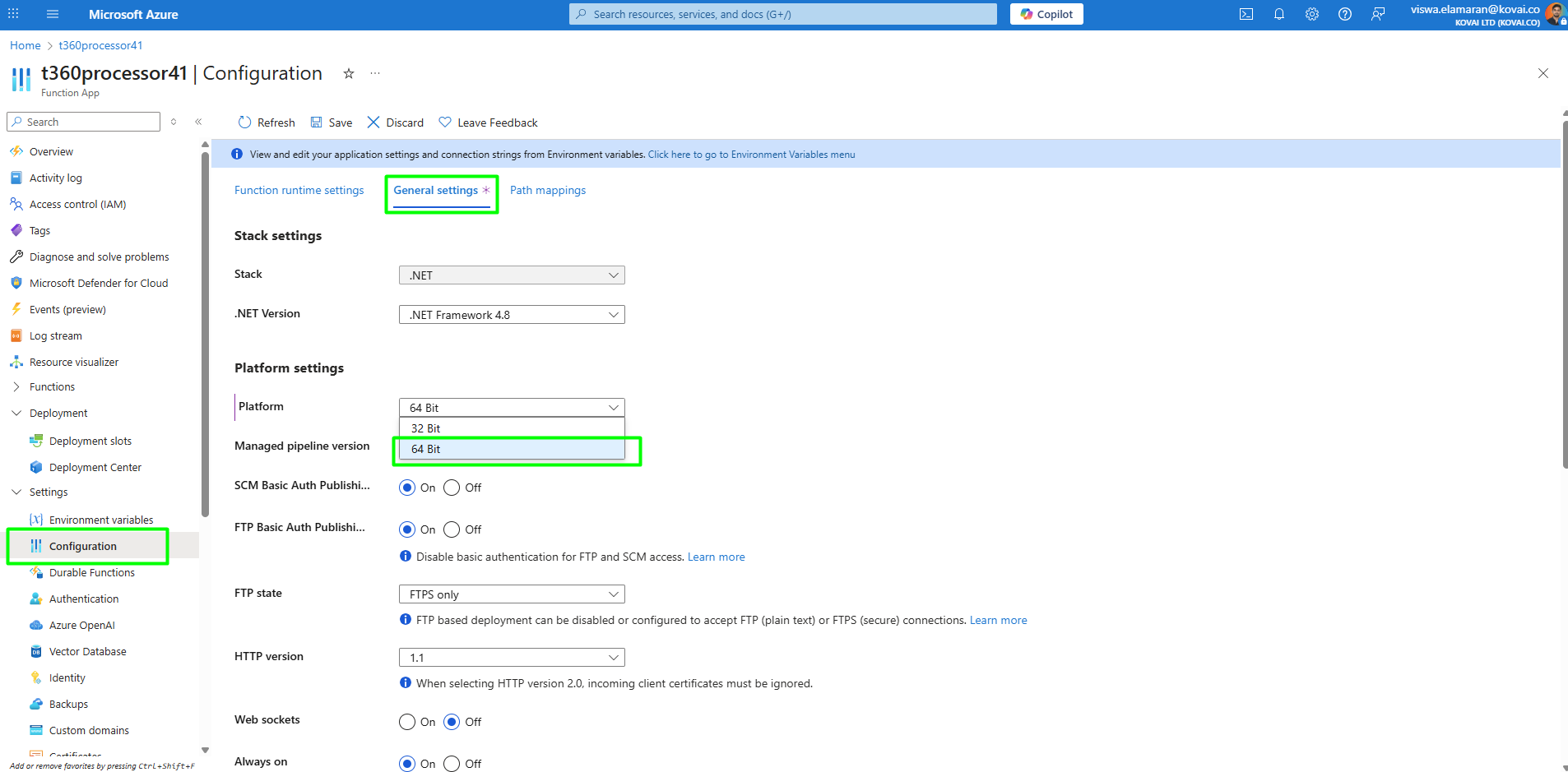
To improve memory optimization and overall performance, update the platform settings on all Function Apps after upgrading to the 4.9 installer:
- Navigate to Settings > Configuration > General settings for each Function App.
- Set the Platform value to 64-bit.
- Click Save to apply the changes.
Breaking changes in 4.2.0
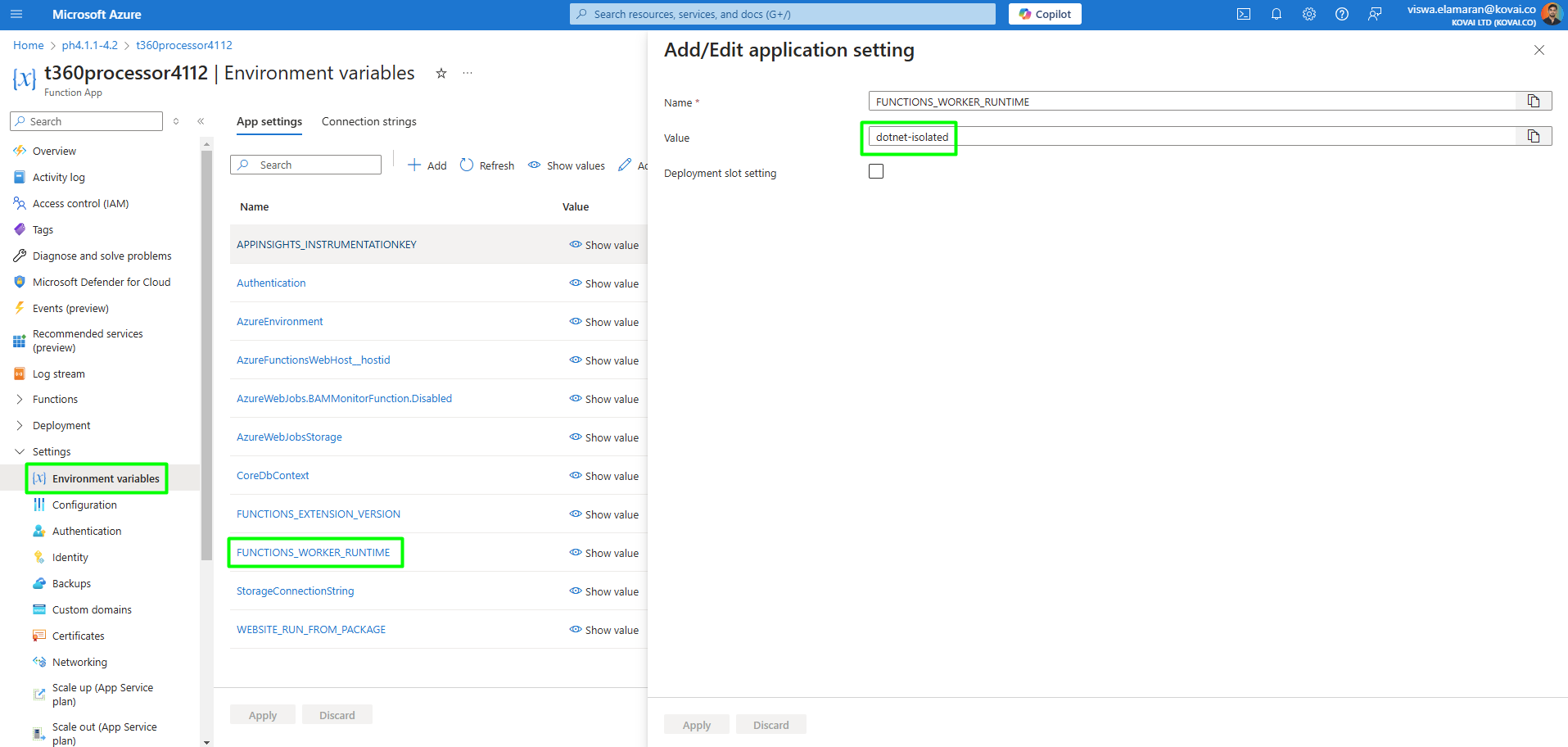
The in-process worker model for Function Apps will be deprecated on November 10, 2026. Microsoft recommends migrating to the isolated worker model. Apply the following to all Function Apps in the Turbo360 instance:
- Update the app setting below for all Function Apps:
| Name | Value |
|---|---|
| FUNCTIONS_WORKER_RUNTIME | dotnet-isolated |
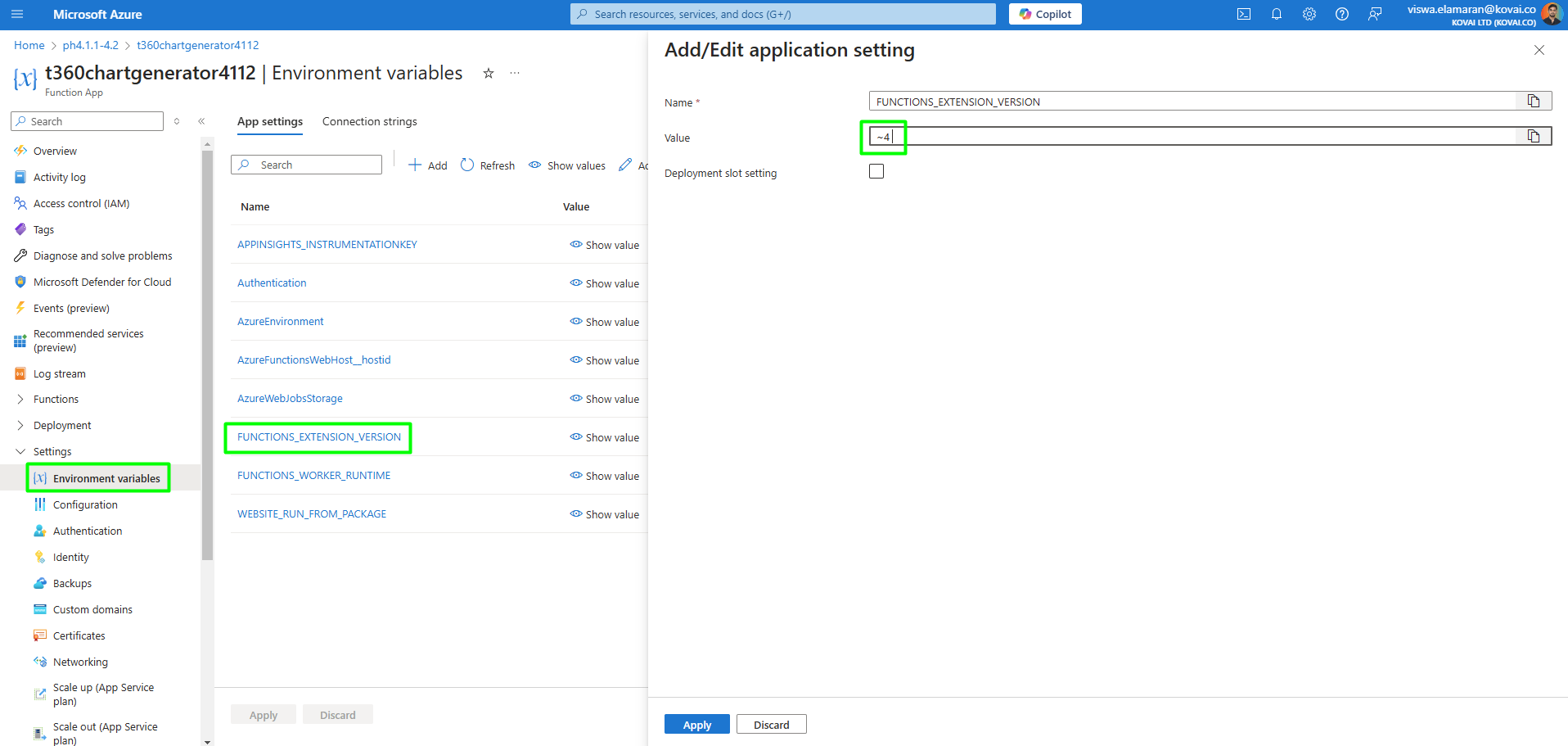
- Add the following app setting to the Chart Generator Function App only:
| Name | Value |
|---|---|
| FUNCTIONS_EXTENSION_VERSION | ~4 |
Breaking changes in 3.6.0
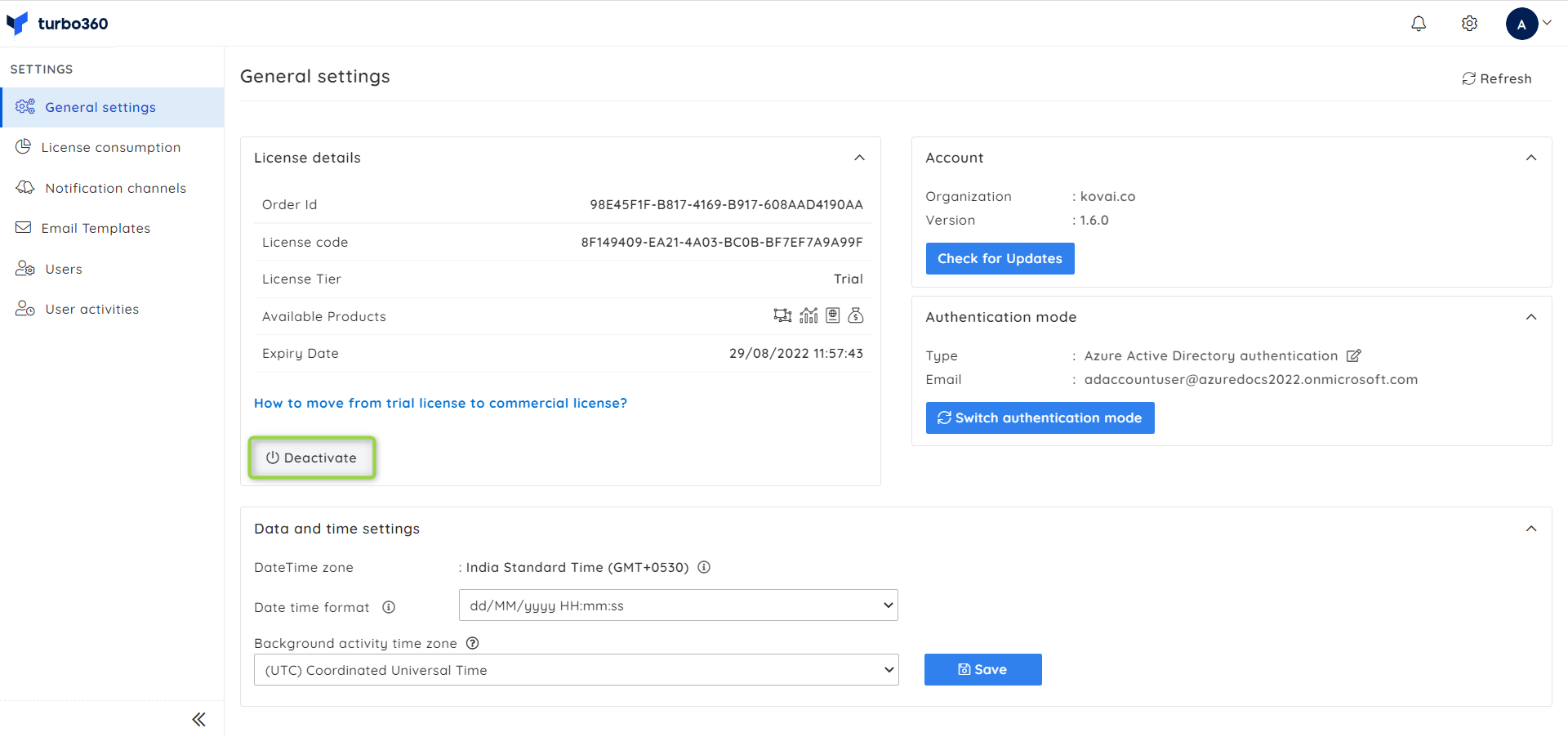
Turbo360 now uses a new license model. Existing customers are not impacted, but the license must be deactivated and reactivated once for seamless operation.
Breaking changes in 3.4.0
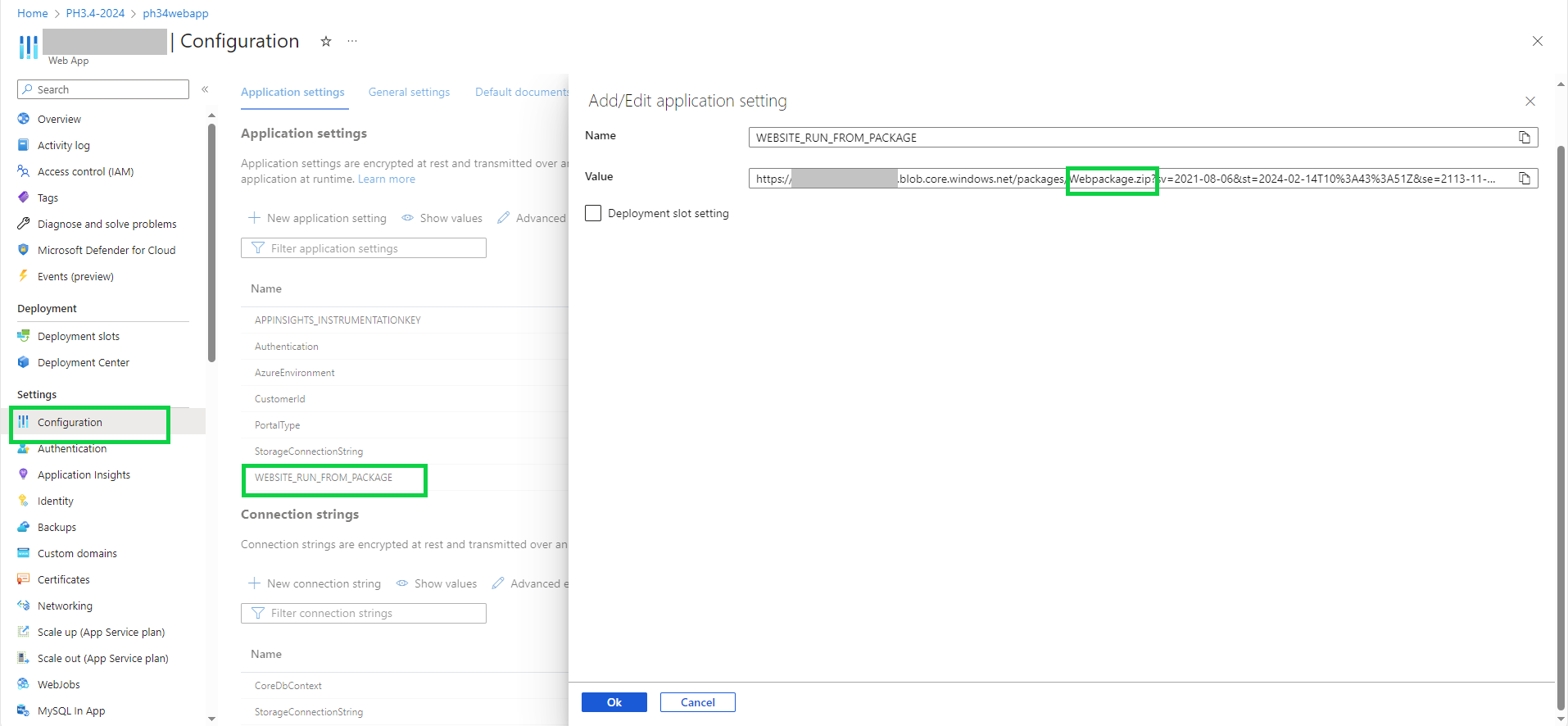
Serverless360 was rebranded as Turbo360. The Web App configuration must be updated:
- In the Azure portal, open the Web App and navigate to Configuration under Settings.
- Update the
WEBSITE_RUN_FROM_PACKAGEapplication setting. - Open the Storage Account and navigate to the container named packages. Generate a SAS URL for the blob Webpackage.zip (set the expiration time to more than 2 years).
- Replace the
WEBSITE_RUN_FROM_PACKAGEvalue with the SAS URL.
Breaking changes in 2.0.0
Starting from version 2.0.0, only one Web App is used (down from two in version 1.9.0). The configuration from the backend Web App must be copied to the frontend Web App before upgrading.
The Web App to update is: sl360-xxxxxxxx-xxxx-xxxx-xxxx-xxxxxxxxxxxx-frontend-webapp
- In the Azure portal, open
sl360-xxxxxxxx-xxxx-xxxx-xxxx-xxxxxxxxxxxx-backend-webappand navigate to Configuration under Settings. - Under Application settings, click Advanced edit and copy the content. Paste it into the Application settings of
sl360-xxxxxxxx-xxxx-xxxx-xxxx-xxxxxxxxxxxx-frontend-webapp. - Under Connection strings, click Advanced edit and copy the content. Paste it into the Connection strings of
sl360-xxxxxxxx-xxxx-xxxx-xxxx-xxxxxxxxxxxx-frontend-webapp.
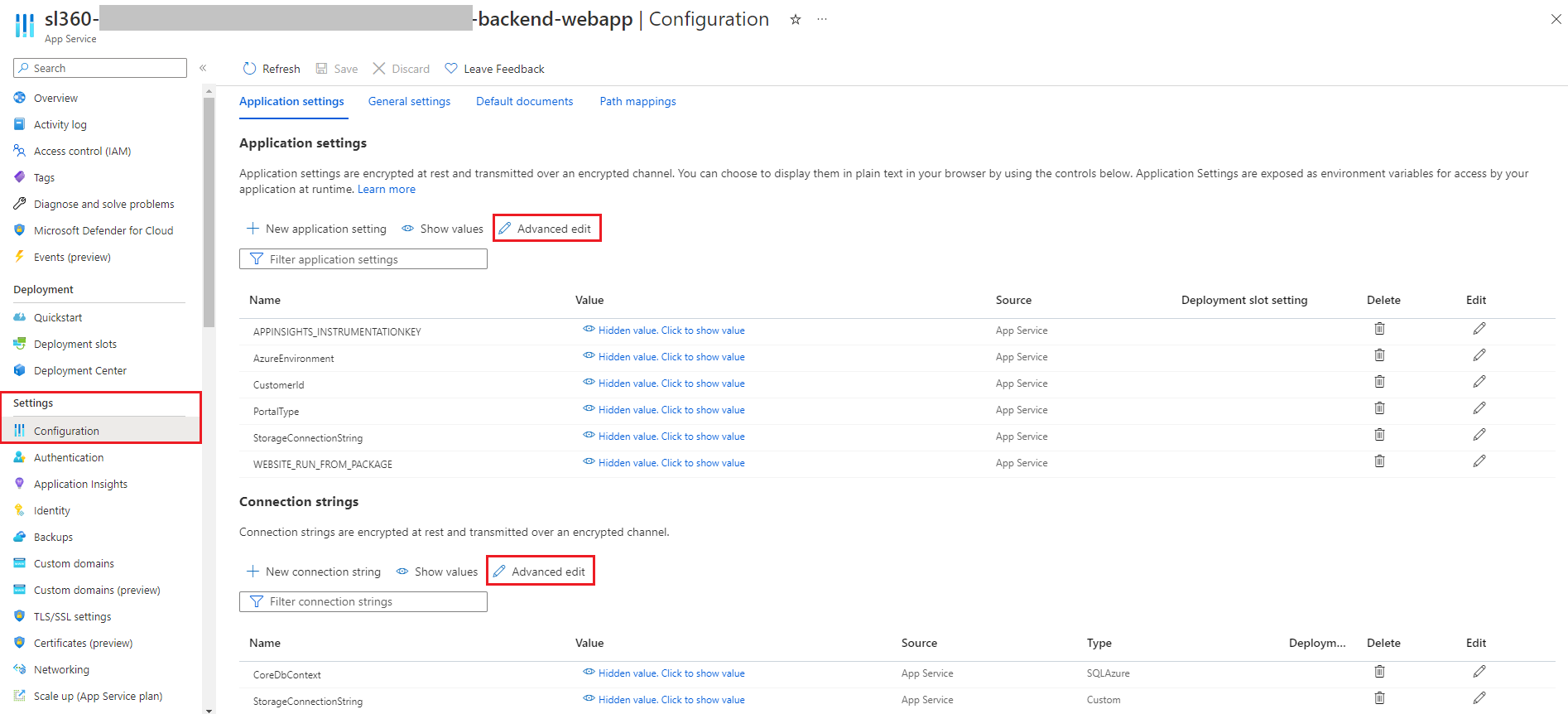
Proceed with the upgrade from the Turbo360 installer. After the upgrade completes successfully, continue with the steps below.
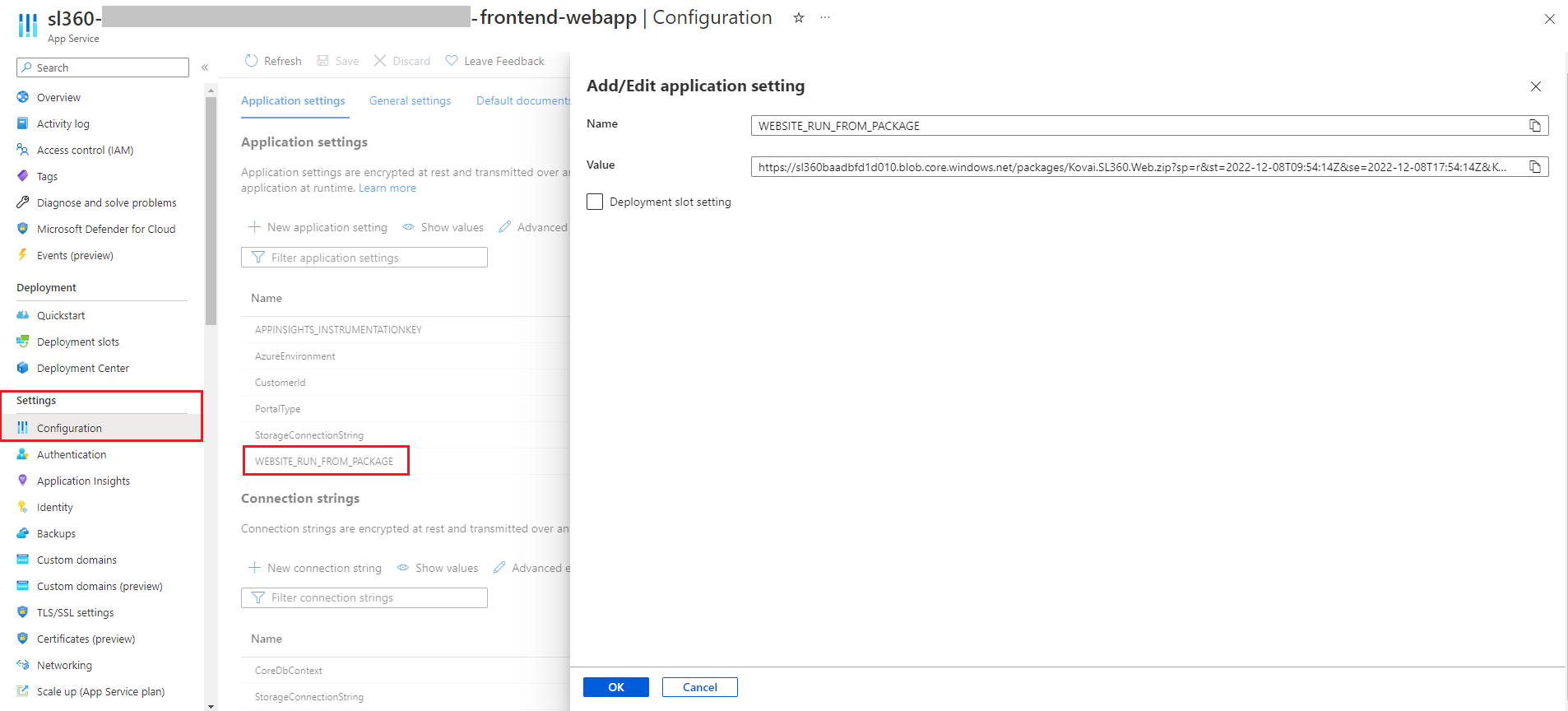
- Update the
WEBSITE_RUN_FROM_PACKAGEsetting insl360-xxxxxxxx-xxxx-xxxx-xxxx-xxxxxxxxxxxx-frontend-webapp. - Open the Storage Account named
sl360xxxxxxxxxxxxand navigate to the packages container. Generate a SAS URL for the blob Kovai.SL360.Web.zip (set the expiration time to more than 2 years).
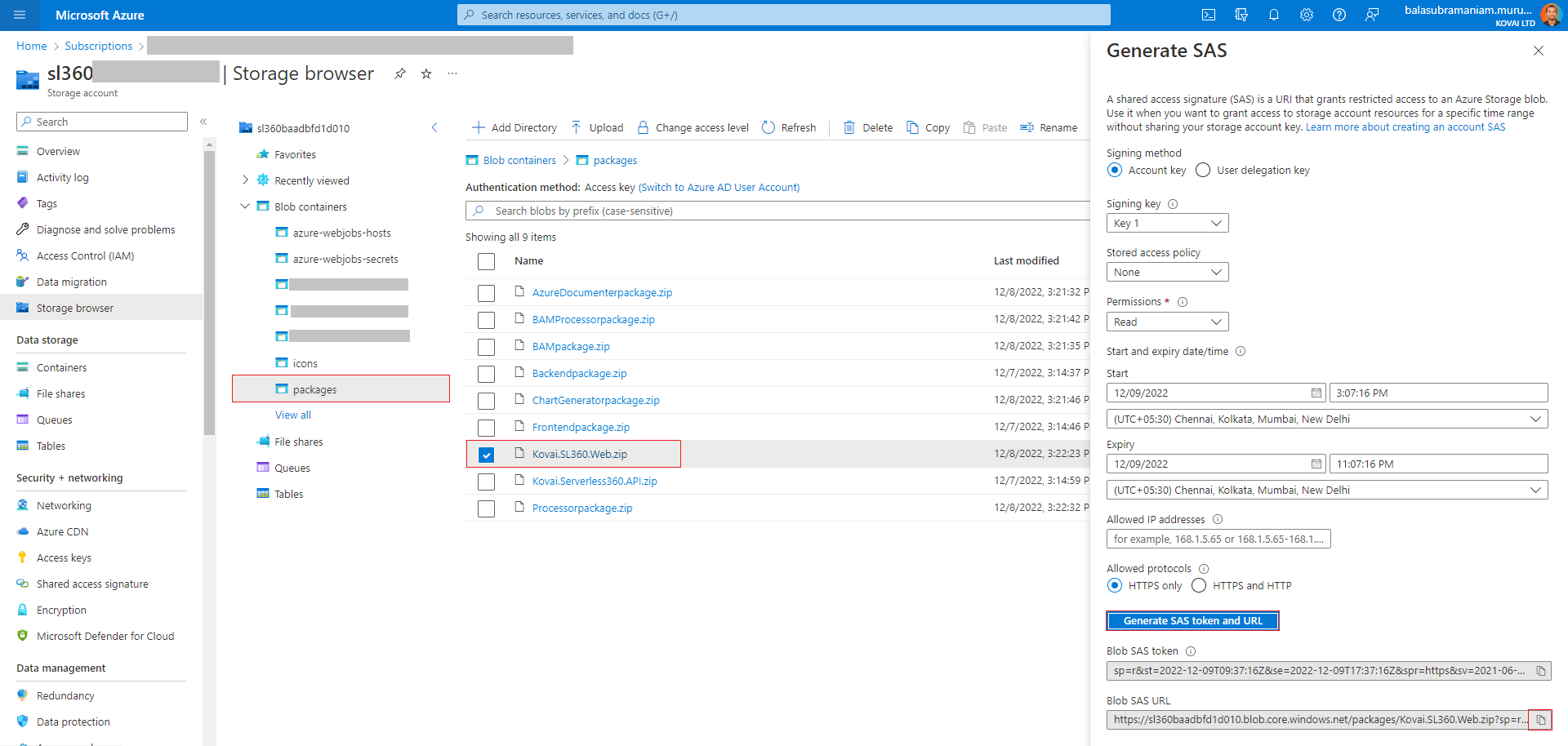
- Update the
WEBSITE_RUN_FROM_PACKAGEsetting with the SAS URL.
- The Web App
sl360-xxxxxxxx-xxxx-xxxx-xxxx-xxxxxxxxxxxx-backend-webappis no longer needed and can be deleted.
Breaking changes in 1.7.0
Starting from version 1.7.0, Turbo360 deploys Function Apps using runtime version 4.x. Existing Function Apps must be manually upgraded to version 4.0.
The following Function Apps must be upgraded:
sl360-xxxxxxxx-xxxx-xxxx-xxxx-xxxxxxxxxxxx-functionappsl360-xxxxxxxx-xxxx-xxxx-xxxx-xxxxxxxxxxxx-ad-functionapp
(The following are required only if the BAM module is configured:)
sl360bam-xxxxxxxxxxxxxxxxxxxxxxxxxxxxxxxx-fnappsl360bamprocessor-xxxxxxxxxxxxxxxxxxxxxxxxxxxxxxxx-fnapp
Set the FUNCTIONS_EXTENSION_VERSION app setting to ~4 in each Function App listed above.
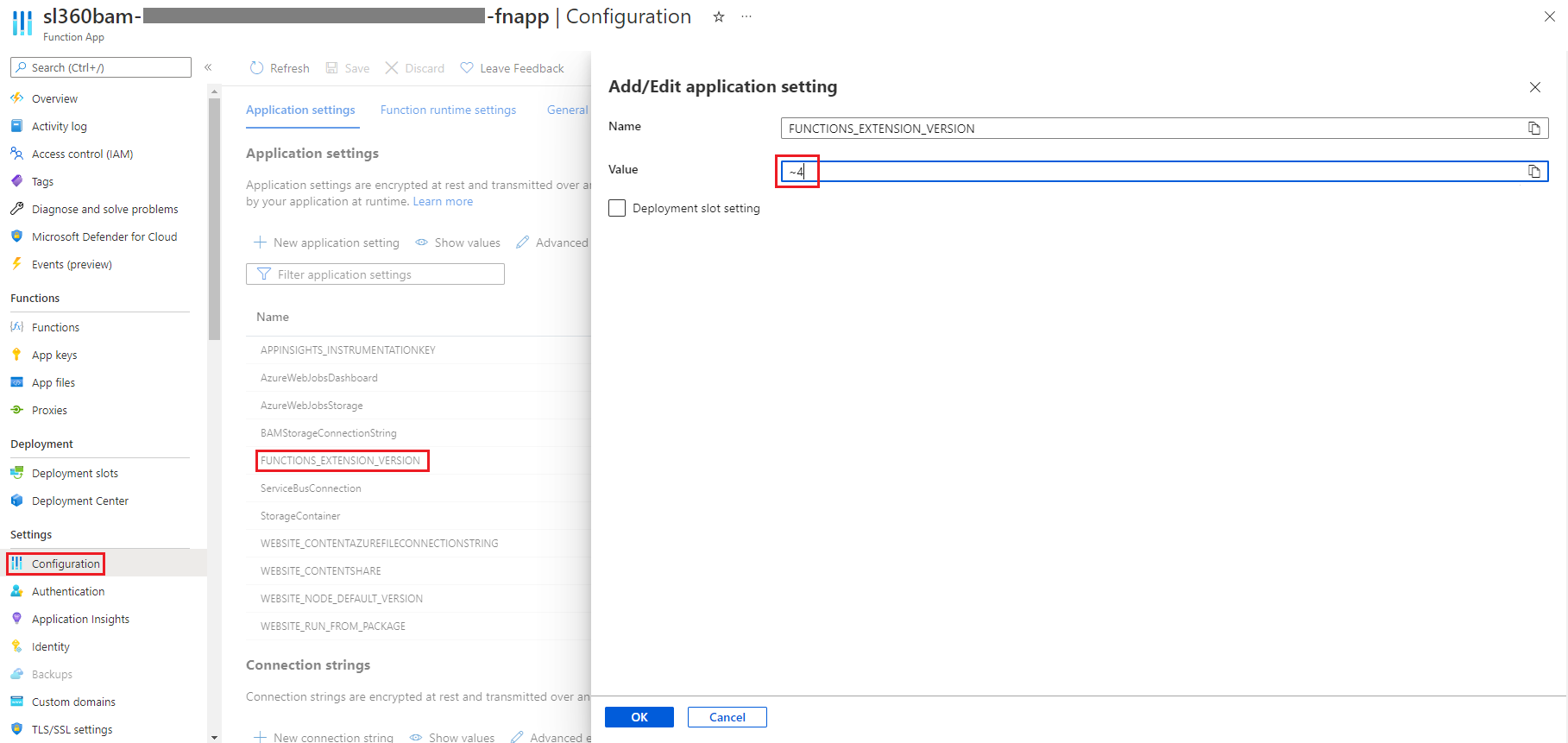
In addition, add the AzureFunctionsWebHost__hostid app setting with the following values per Function App:
sl360-xxxxxxxx-xxxx-xxxx-xxxx-xxxxxxxxxxxx-functionapp:processorsl360-xxxxxxxx-xxxx-xxxx-xxxx-xxxxxxxxxxxx-ad-functionapp:documenter
(BAM only:)
sl360bam-xxxxxxxxxxxxxxxxxxxxxxxxxxxxxxxx-fnapp:bamsl360bamprocessor-xxxxxxxxxxxxxxxxxxxxxxxxxxxxxxxx-fnapp:bamprocessor

Finally, add the following setting to all Function Apps:
| Key | Value |
|---|---|
| FUNCTIONS_WORKER_RUNTIME | dotnet |

The Function App sl360-xxxxxxxx-xxxx-xxxx-xxxx-xxxxxxxxxxxx-ad-cg-functionapp requires no action. It runs on version 1 and is supported for the long term.
Configuration
The Upgrade flow in the installer requires the following inputs:
| Field | Description |
|---|---|
| SQL database connection string | Connection string for the deployed SQL database, retrieved from Web App environment variables |
| Storage account connection string | Connection string for the deployed Storage Account, retrieved from Web App environment variables |
Connection strings are available in the Azure portal under the Web App: Settings > Environment variables > Connection strings.
Permission behavior
With the required roles: The installer validates connections, checks for updates, and applies the upgrade without interruption.
Without sufficient permissions: Upgrade steps that require resource modifications (app setting updates, redeployment of Function Apps) will fail. Ensure the service principal has Contributor rights on the target resource group.
Example scenario
A platform administrator needs to upgrade their Turbo360 private instance from version 4.1.0 to the latest release. They download the new installer, open the Upgrade option, retrieve connection strings from the Web App's environment variables, validate them, and click Check for Updates. They review the 4.2.0 breaking changes, apply the required FUNCTIONS_WORKER_RUNTIME app setting update to all Function Apps, then start the upgrade. The instance is updated to the latest version successfully.
Limitations
- Upgrades on VNet-enabled instances must be performed from a VM inside the virtual network, or with SQL and Storage public access temporarily re-enabled.
- Breaking changes must be applied manually for each version between your current version and the target. Missing a breaking change step may cause instability.
- The upgrade process modifies live Azure resources. Ensure all users are notified of a maintenance window before starting.
Troubleshooting
-
Connection string validation fails
Cause: The connection strings entered do not match the authentication type used during original deployment, or the resources have been moved or renamed.
Fix: Retrieve the correct connection strings from the Web App's Settings > Environment variables > Connection strings in the Azure portal and re-enter them. -
Check for Updates shows no available version
Cause: The instance is already on the latest version, or the installer cannot reach the Turbo360 update service.
Fix: Verify internet connectivity from the machine running the installer. If the latest version was recently released, wait and retry. -
Upgrade fails after applying breaking changes for 4.2.0
Cause: TheFUNCTIONS_WORKER_RUNTIMEsetting was not updated on all Function Apps, or the Chart Generator app setting was missed.
Fix: Verify thatFUNCTIONS_WORKER_RUNTIMEis set todotnet-isolatedon all Function Apps, andFUNCTIONS_EXTENSION_VERSIONis set to~4on the Chart Generator Function App, then retry. -
Upgrade fails on a VNet-enabled instance
Cause: The installer is running from a machine outside the VNet with public access disabled on SQL and Storage.
Fix: Run the upgrade from a VM inside the VNet, or temporarily enable public network access on SQL and Storage, perform the upgrade, and disable it again. -
Function Apps revert to old runtime version after upgrade
Cause: TheFUNCTIONS_EXTENSION_VERSIONapp setting is missing or set incorrectly.
Fix: SetFUNCTIONS_EXTENSION_VERSIONto~4on the affected Function Apps in the Azure portal and restart them.
FAQs
-
Do I need to apply breaking changes for every version, or only the latest?
Apply breaking changes for every version between your current version and the target version, in ascending order. Skipping a version's breaking changes may cause instability. -
Where do I find the connection strings needed for the upgrade?
Open the Web App for your private instance in the Azure portal. Navigate to Settings > Environment variables > Connection strings to find the SQL and Storage connection strings. -
Can I upgrade directly from a very old version to the latest?
Yes, but you must apply all breaking changes for every intermediate version in order. Review the breaking changes section above and complete each applicable step before starting the installer upgrade.