

Configuring Event Grid Domain automated tasks
- 05 Aug 2026
- 6 Minutes to read
- Print
- DarkLight
- Download PDF
Configuring Event Grid Domain automated tasks
- Updated on 05 Aug 2026
- 6 Minutes to read
- Print
- DarkLight
- Download PDF
Article summary
Did you find this summary helpful?
Thank you for your feedback!
Overview
Event Grid Domain automated tasks lets you send events to Azure Event Grid Domains and Event Grid Domain Topics, and process dead-lettered events in Event Grid Domain Subscriptions. You can use them to verify event delivery across domains with multiple topics and subscriptions, run scheduled or ad-hoc event tests, and recover failed events without switching to the Azure portal.
Business value
Event Grid Domain tasks give you centralised control over multi-domain event testing and dead-letter recovery directly within a Business Application. You can target specific domains or individual domain topics, run parallel delivery tasks, and manage dead letters in a single workflow — reducing the operational overhead of testing complex event routing architectures.
How it works
Turbo360 executes Event Grid Domain tasks against Event Grid Domains and Domain Topics that are associated with a Business Application. You can send events to the domain level (routing is handled by the domain) or directly to a specific domain topic. Each task run is configured with delivery parameters — event count, parallelism, batch size, and optional think time. For dead-letter processing, Turbo360 reads events from the associated Storage Blob container and resubmits or deletes them based on your chosen operation mode.
Steps
Use the following steps to configure and run Event Grid Domain automated tasks. Navigate to the relevant Business Application in Turbo360 and open the Automated tasks section to get started.
Send events to an Event Grid Domain
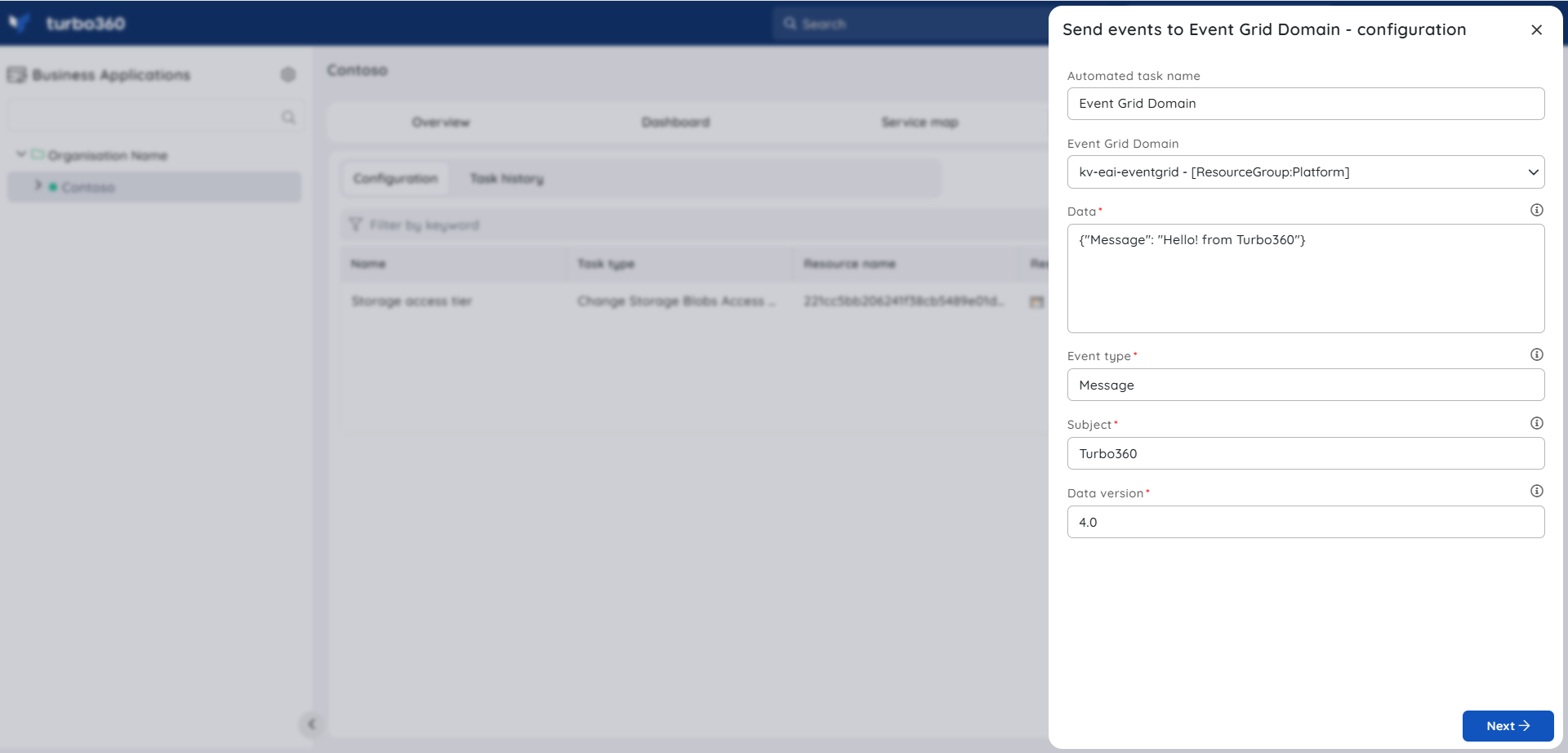
Sending events to an Event Grid Domain lets you test delivery across all topics and subscriptions in the domain simultaneously, or validate a specific domain when multiple domains are associated with the same Business Application.
Select the Event Grid Domain associated with your Business Application.
Enter the event data payload. Optionally define the following event properties:
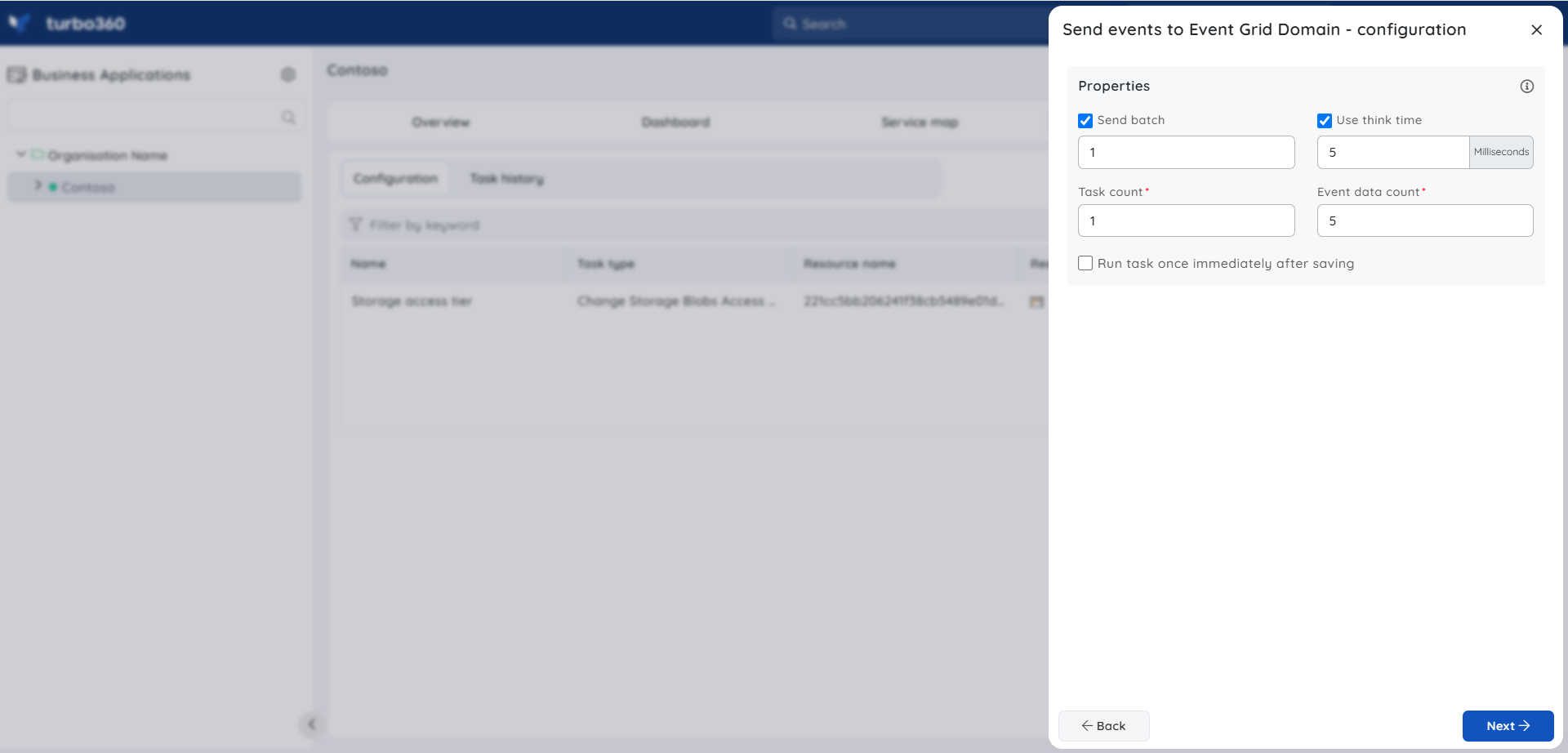
Property Description Subject Publisher-defined path to the event subject Data Version Schema version of the data object, defined by the publisher Event Type One of the registered event types for this event source Configure the delivery parameters:
- Event Data count — total number of events to send (maximum 10,000).
- Task count — number of parallel tasks (maximum 10). For example, with an event count of 100 and a task count of 2, the task sends 50 events per task in parallel.
- Batch count — number of events per batch (maximum batch size 10).
- Think time — optional wait time between each event or batch, used to simulate delayed delivery.
Save and run the task.
Send events to an Event Grid Domain Topic
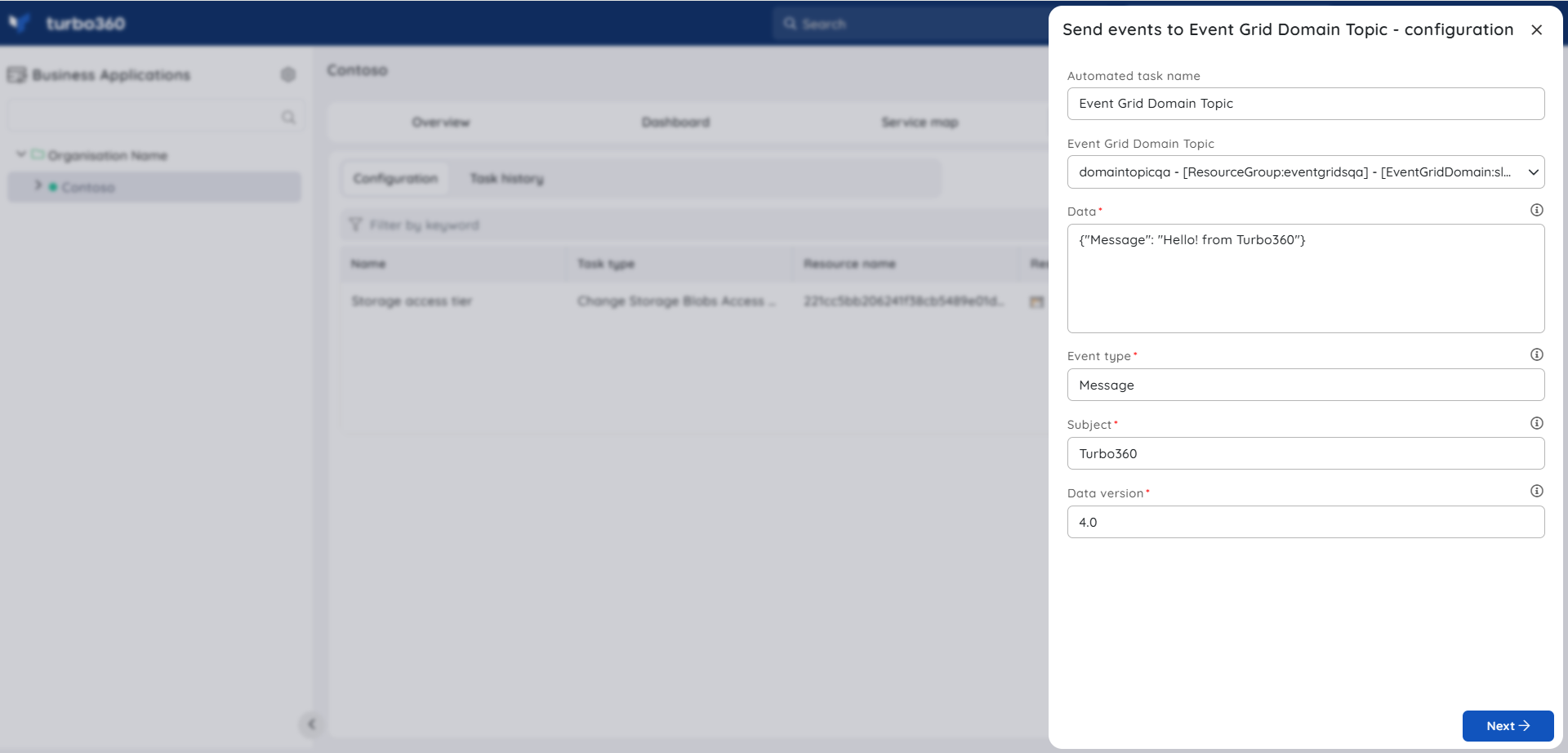
Sending events to an Event Grid Domain Topic lets you verify that all downstream Domain Subscriptions for a specific topic receive the published events, and supports load and performance testing of individual topic pipelines.
Select the Event Grid Domain Topic associated with your Business Application.
Enter the event data payload. Optionally define the following event properties:
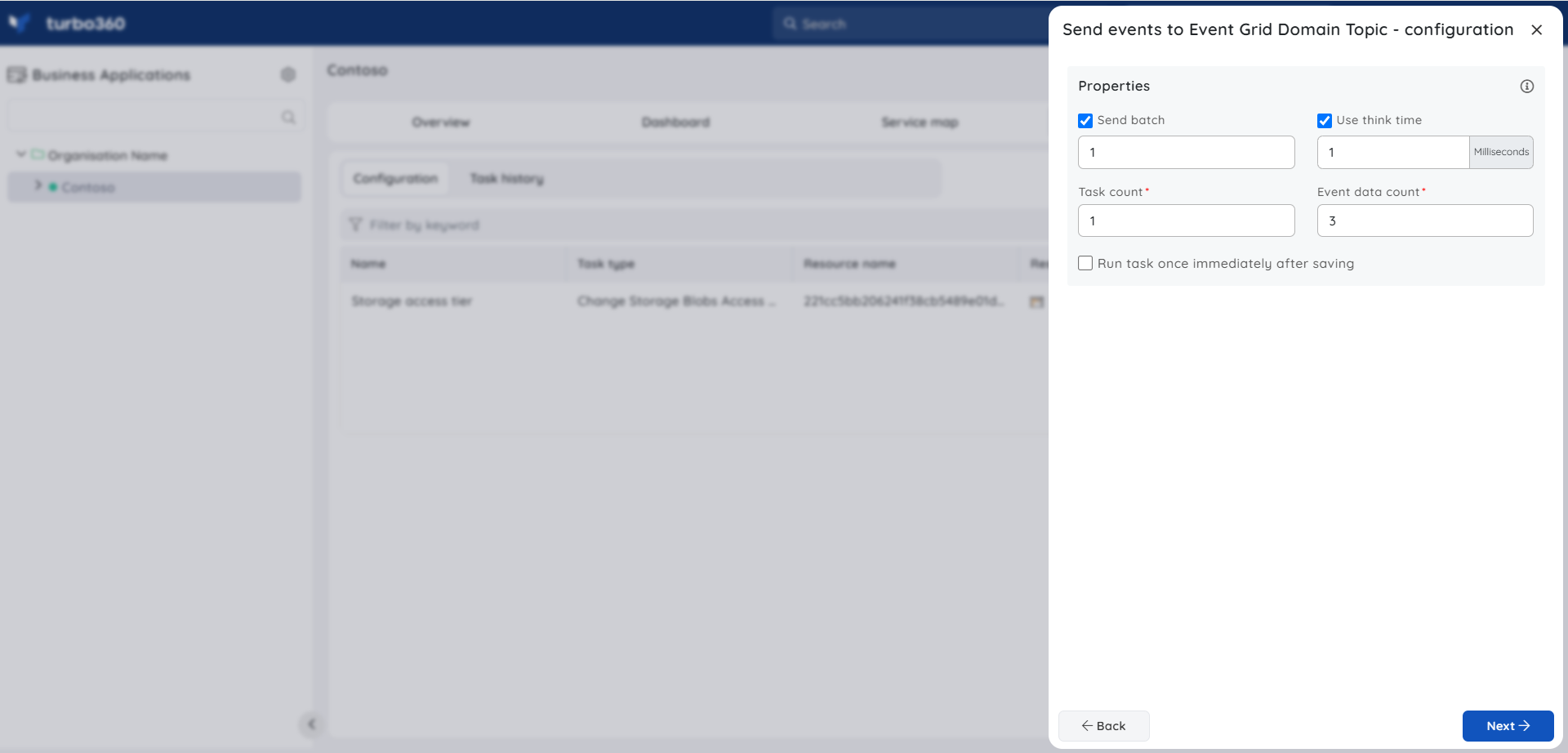
Property Description Subject Publisher-defined path to the event subject Data Version Schema version of the data object, defined by the publisher Event Type One of the registered event types for this event source Configure the delivery parameters:
- Event Data count — total number of events to send (maximum 10,000).
- Task count — number of parallel tasks (maximum 10).
- Batch count — number of events per batch (maximum batch size 10).
- Think time — optional wait time between each event or batch, used to simulate delayed delivery.
Save and run the task.
Process dead letters in an Event Grid Domain Subscription
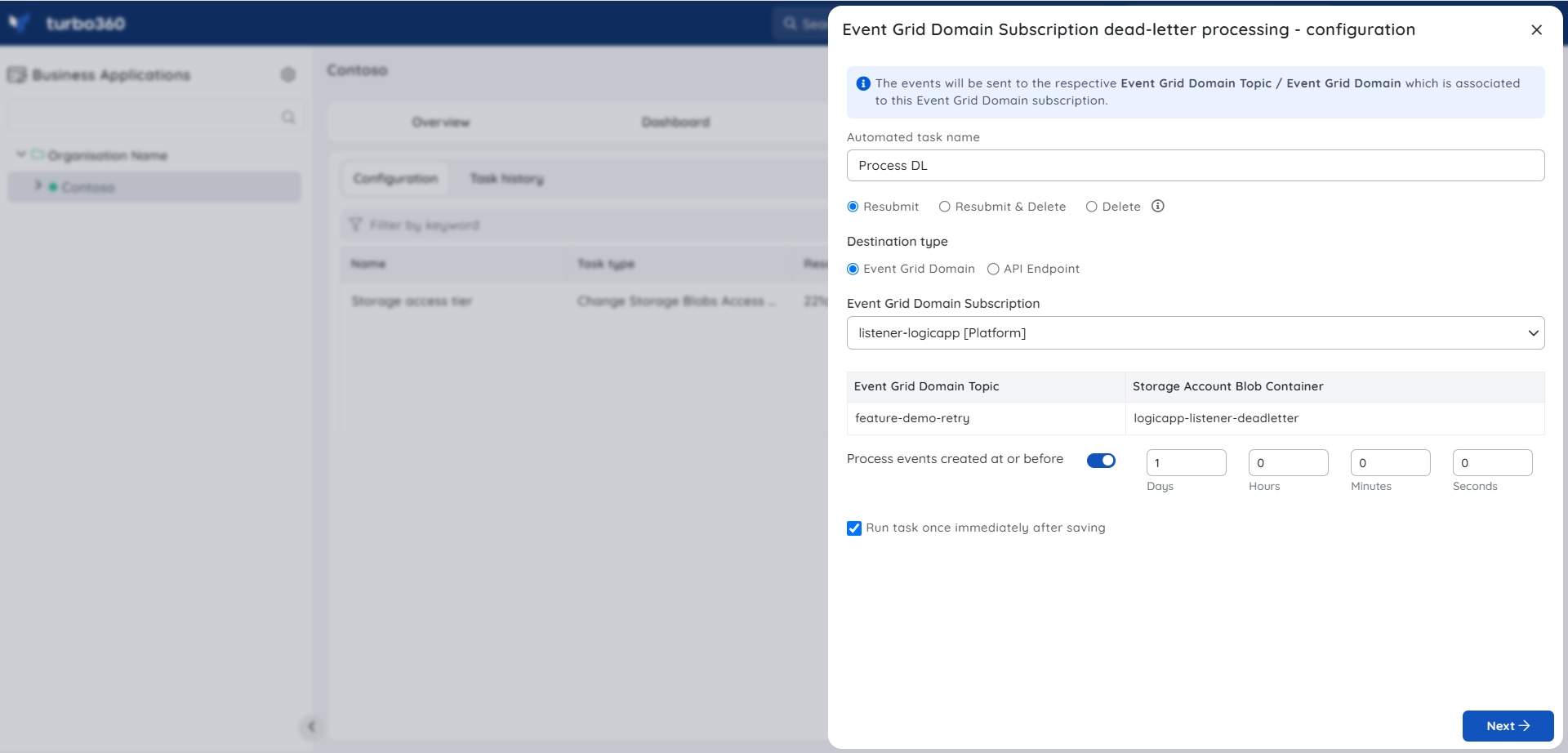
Processing dead letters lets you recover failed events from the associated Storage Blob container and resubmit them to the Event Grid Domain, or remove them when they are no longer needed.
You must associate the corresponding Event Grid Domain Topic, Event Grid Domain Subscription, and Storage Blob container with the Business Application before you can process dead-lettered events.
- Select the Event Grid Domain Subscription from which you want to process dead letters.
- Choose a processing mode:
- Resubmit messages — sends a copy of each dead-lettered event back to the Event Grid Domain. The original remains in the blob container.
- Resubmit and Delete messages — sends a copy of each event to the Event Grid Domain and removes the original from the blob container.
- Delete messages — removes events from the blob container without resubmitting them.
- Optionally specify a time range to process only events created within that window. Leave blank to process all available dead-lettered events.
- Save and run the task.
Configuration
The following options are available when configuring an Event Grid Domain automated task.
| Option | Description |
|---|---|
| Event Data count | Total number of events to send. Maximum: 10,000. |
| Task count | Number of parallel delivery tasks. Maximum: 10. |
| Batch count | Number of events per batch. Maximum batch size: 10. |
| Think time | Wait duration between each event or batch delivery. Optional. |
| Subject | Publisher-defined path to the event subject. |
| Data Version | Schema version of the event data object. |
| Event Type | Registered event type for this event source. |
Alert configuration
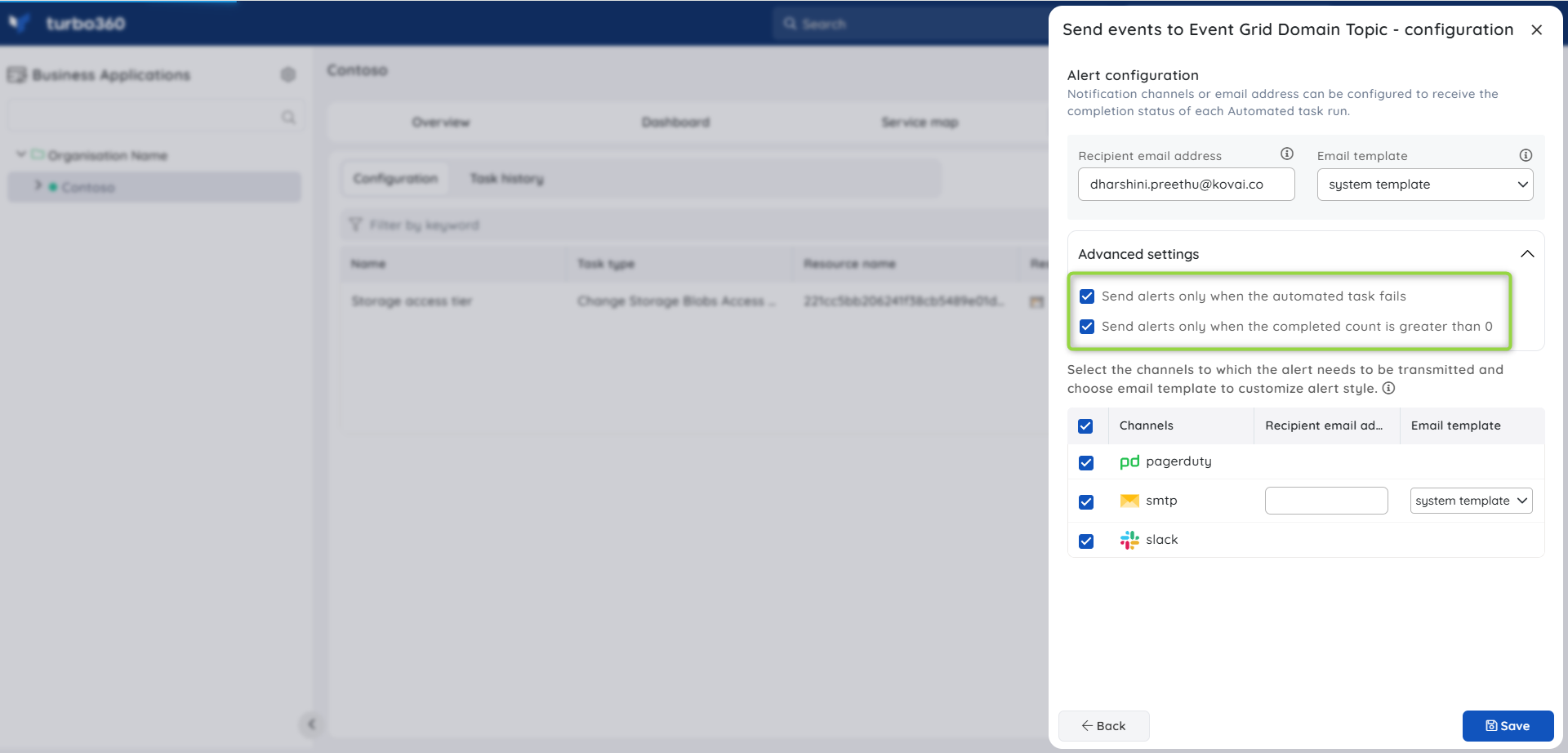
You can configure notification channels and recipient email addresses to receive alerts when an Event Grid Domain task completes or fails.
Under Advanced settings, select one or both of the following options:
- Send alerts only when the automated task fails — notifications are sent only when the task fails.
- Send alerts only when the completed count is greater than 0 — notifications are sent only when at least one event was processed successfully.
When both options are selected, you receive a notification if the task fails or if the completed count exceeds 0.
Troubleshooting
Events sent to the domain but not received by subscriptions on a specific topic
Cause: The target domain topic may not be associated with the Business Application, or the domain subscription filter is excluding the events.
Fix: Verify that the domain topic and its subscriptions are associated with the Business Application and that subscription filters match the event type and subject used in the task.Dead-letter processing fails with an access error
Cause: The Storage Blob container is not associated with the Business Application, or the service principal lacks read/delete permissions on the container.
Fix: Associate the Storage Blob container with the Business Application and confirm that the service principal has the required permissions on the container.Task completes but completed count remains 0
Cause: The event payload may be malformed, or the Event Grid Domain endpoint is not reachable from Turbo360.
Fix: Validate the event payload format and confirm that the Event Grid Domain endpoint is accessible. Check the task run log for delivery error details.Sending to domain delivers events but the wrong topic receives them
Cause: When sending to the domain level, Azure routes events based on the subject prefix or filter configured on each topic's subscription. An incorrect subject in the payload may cause routing to an unintended topic.
Fix: Send directly to the specific domain topic instead of the domain, or adjust the subject in the event payload to match the intended topic's subscription filter.Think time has no effect on delivery speed
Cause: Think time is applied per event or batch, not per task. With high task counts and low think time, parallel tasks may complete before the delay has a visible effect.
Fix: Reduce the task count or increase the think time to observe the intended pacing effect.
FAQs
What is the difference between sending to a domain versus sending to a domain topic?
Sending to the domain routes events based on the subject and filters configured on each domain topic's subscriptions. Sending directly to a domain topic delivers events only to subscriptions on that specific topic, giving you more precise control over which subscriptions receive the events.Can I process dead letters from a domain subscription and a domain topic subscription in the same task?
No. Each task targets a single Event Grid Domain Subscription. Run separate tasks to process dead letters from different subscriptions.Can I use a time range to target a subset of dead-lettered events?
Yes. When you specify a time range in the dead-letter processing configuration, Turbo360 processes only events created at or before the end of that range. Leave the time range blank to process all available dead-lettered events.
Related articles
Was this article helpful?