

Configuring Event Hub automated tasks
- 05 Aug 2026
- 4 Minutes to read
- Print
- DarkLight
- Download PDF
Configuring Event Hub automated tasks
- Updated on 05 Aug 2026
- 4 Minutes to read
- Print
- DarkLight
- Download PDF
Article summary
Did you find this summary helpful?
Thank you for your feedback!
Overview
Event Hub tasks are automated tasks in Turbo360 that send events to Azure Event Hubs associated with a Business Application. You can use them to produce test events for QA and development, run load and performance tests against your Event Hub integration, and verify that your event processing pipeline behaves correctly under realistic conditions.
Business value
Event Hub tasks let you validate event flow health without building separate test tooling or switching to the Azure portal. You can send high-volume parallelised event batches with configurable pacing directly from Turbo360, reducing the time needed to identify integration issues and confirm system readiness before production deployments.
How it works
Turbo360 executes Event Hub tasks against Event Hub resources associated with a Business Application. Each task run is configured with delivery parameters — event count, parallelism, batch size, and optional think time — giving you control over throughput and pacing. Turbo360 sends the configured events to the selected Event Hub endpoint and reports a completion count on each run.
Steps
Use the following steps to configure and run an Event Hub automated task. Navigate to the relevant Business Application in Turbo360 and open the Automated tasks section to get started.
Send events to an Event Hub
Sending events to an Event Hub lets you simulate production-level throughput, verify that downstream consumers receive events correctly, and measure Event Hub performance under load.
- Select the Event Hub resource associated with your Business Application.
- Enter the event data payload.
- Configure the delivery parameters:
- Event Data count — total number of events to send (maximum 10,000).
- Task count — number of parallel tasks (maximum 10). For example, with an event count of 100 and a task count of 2, the task sends 50 events per task in parallel.
- Batch count — number of events per batch (maximum batch size 10).
- Think time — optional wait time between each event or batch, used to simulate delayed delivery or reduce throughput for pacing tests.
- Save and run the task.
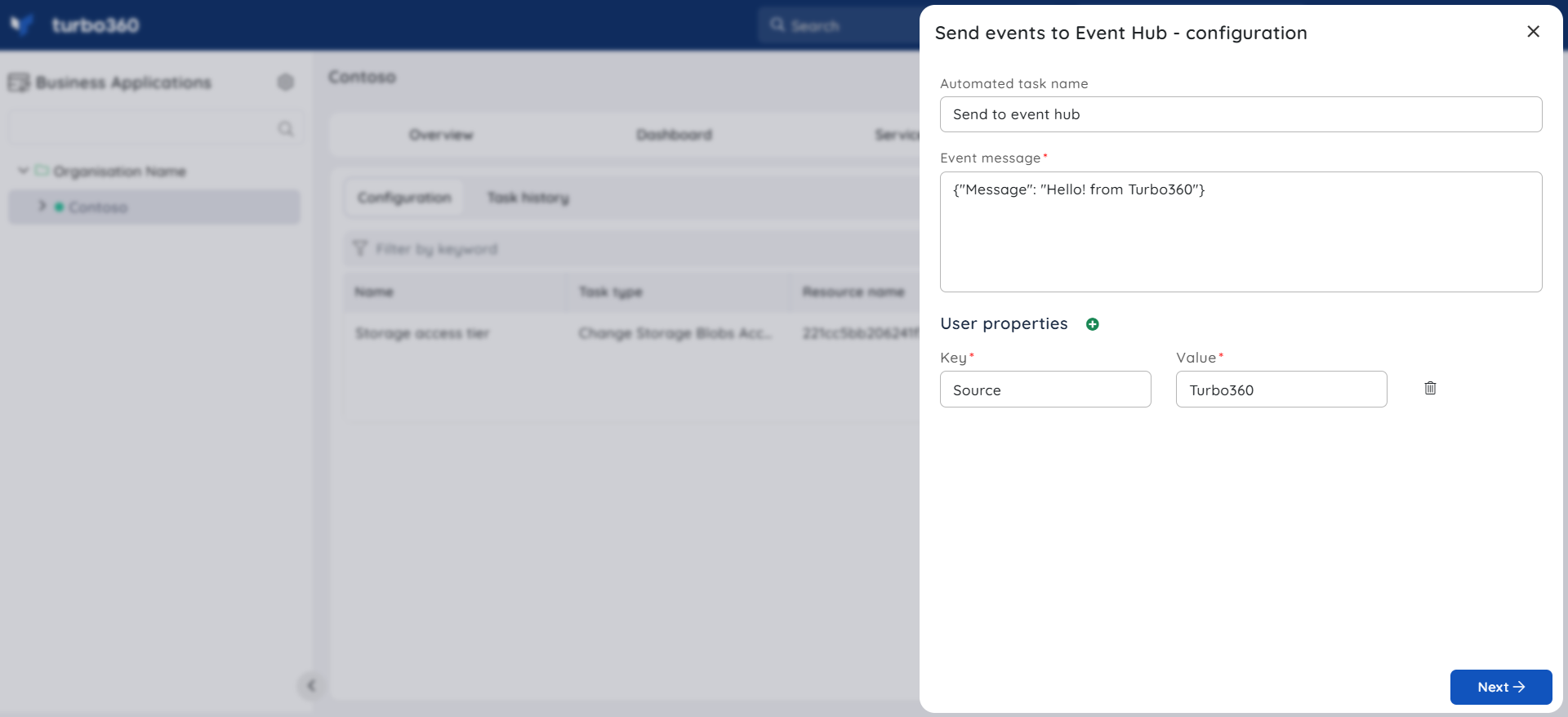
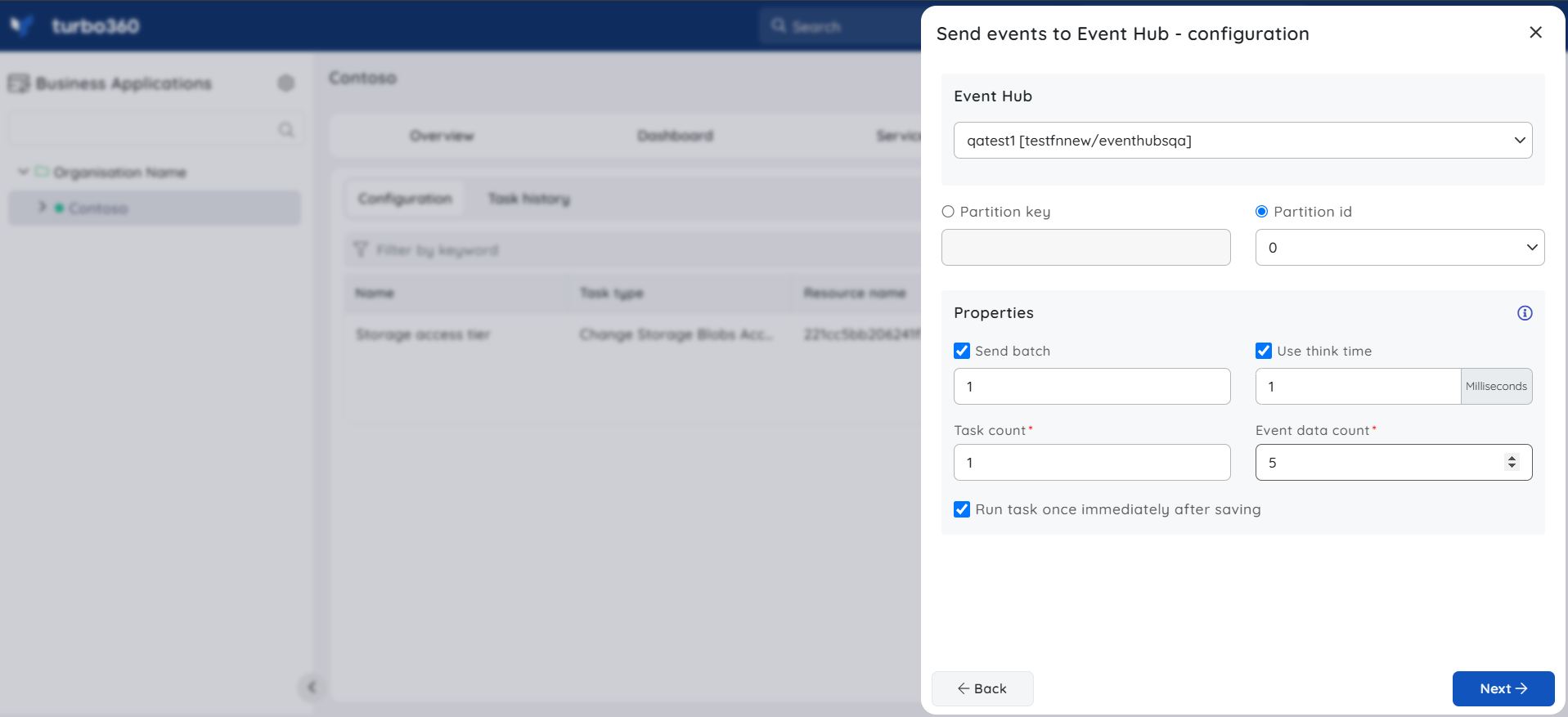
Configuration
The following options are available when configuring an Event Hub automated task.
| Option | Description |
|---|---|
| Event Data count | Total number of events to send. Maximum: 10,000. |
| Task count | Number of parallel delivery tasks. Maximum: 10. |
| Batch count | Number of events per batch. Maximum batch size: 10. |
| Think time | Wait duration between each event or batch delivery. Optional. |
Alert configuration
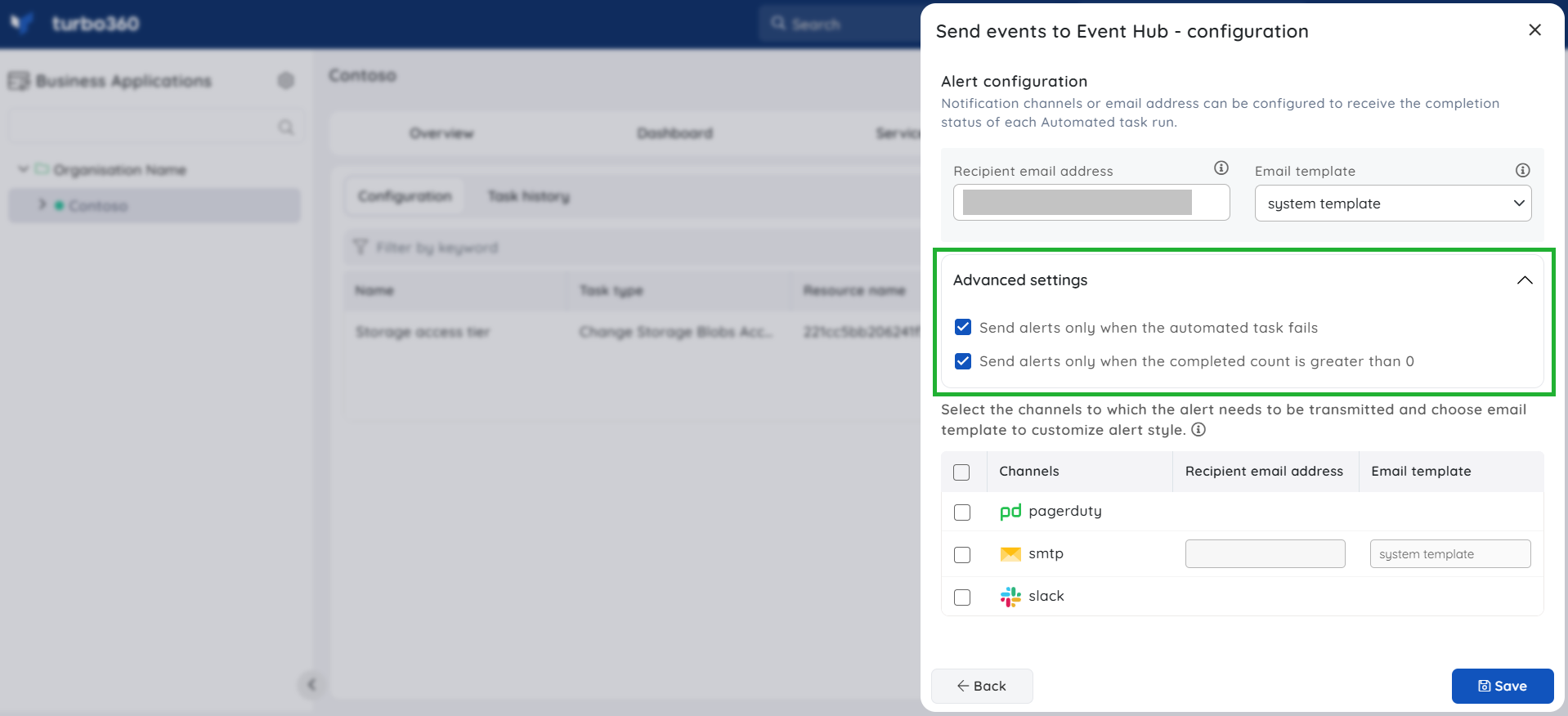
You can configure notification channels and recipient email addresses to receive alerts when an Event Hub task completes or fails.
Under Advanced settings, select one or both of the following options:
- Send alerts only when the automated task fails — notifications are sent only when the task fails.
- Send alerts only when the completed count is greater than 0 — notifications are sent only when at least one event was processed successfully.
When both options are selected, you receive a notification if the task fails or if the completed count exceeds 0.
Troubleshooting
Task completes but completed count remains 0
Cause: The event payload may be malformed, or the Event Hub endpoint is not reachable from Turbo360.
Fix: Validate the event payload format and confirm that the Event Hub endpoint is accessible. Check the task run log for delivery error details.Task fails with an authentication error
Cause: The service principal associated with the Business Application may not have the required permissions on the Event Hub namespace or hub.
Fix: Confirm that the service principal has the Azure Event Hubs Data Sender role on the target Event Hub or namespace.Events are sent but not processed by downstream consumers
Cause: Downstream consumers may be targeting a different consumer group, or the Event Hub partition key is routing events away from the consumer's assigned partition.
Fix: Verify that downstream consumers are connected to the correct consumer group and that the partition configuration in the task matches the consumer's expectations.Think time has no effect on delivery speed
Cause: Think time is applied per event or batch, not per task. With high task counts and low think time, parallel tasks may complete before the delay has a visible effect.
Fix: Reduce the task count or increase the think time to observe the intended pacing effect.Event Hub task does not appear in the Automated Tasks list
Cause: The Event Hub resource may not be associated with the Business Application.
Fix: Associate the Event Hub resource with the Business Application before creating an automated task for it.
FAQs
Can I send events to multiple Event Hubs in a single task?
No. Each Event Hub task targets a single Event Hub resource. Create separate tasks for each Event Hub you want to test.What is the maximum number of events I can send in a single task run?
The maximum is 10,000 events per task run. Use the Task count parameter to distribute delivery across parallel tasks, and Batch count to control how many events are sent per batch.Does think time apply to each event individually or to each batch?
Think time applies per event or per batch depending on how you configure the task. If you set a batch count greater than 1, the think time wait occurs after each batch is sent, not after each individual event.
Related articles
Was this article helpful?