Overview
Network topology diagram is a document type in Azure Documenter that generates a visual representation of the network layout across Azure resources. It maps virtual networks and their interconnected resources into an XML file compatible with draw.io for easy visualization.
Business value
Network topology diagrams give administrators and architects a single visual reference for network topology and resource dependencies across Azure subscriptions, reducing the manual effort of mapping infrastructure and speeding up architecture reviews and troubleshooting.
Prerequisites
Required permissions
| Role | Permission level | Access |
|---|---|---|
| Account owner, Owner, Contributor | — | Full access to the Documentation section |
| Custom role | Read | View documents generated under Documentation |
| Custom role | Manage | View, generate, and manage documents under Documentation |
How it works
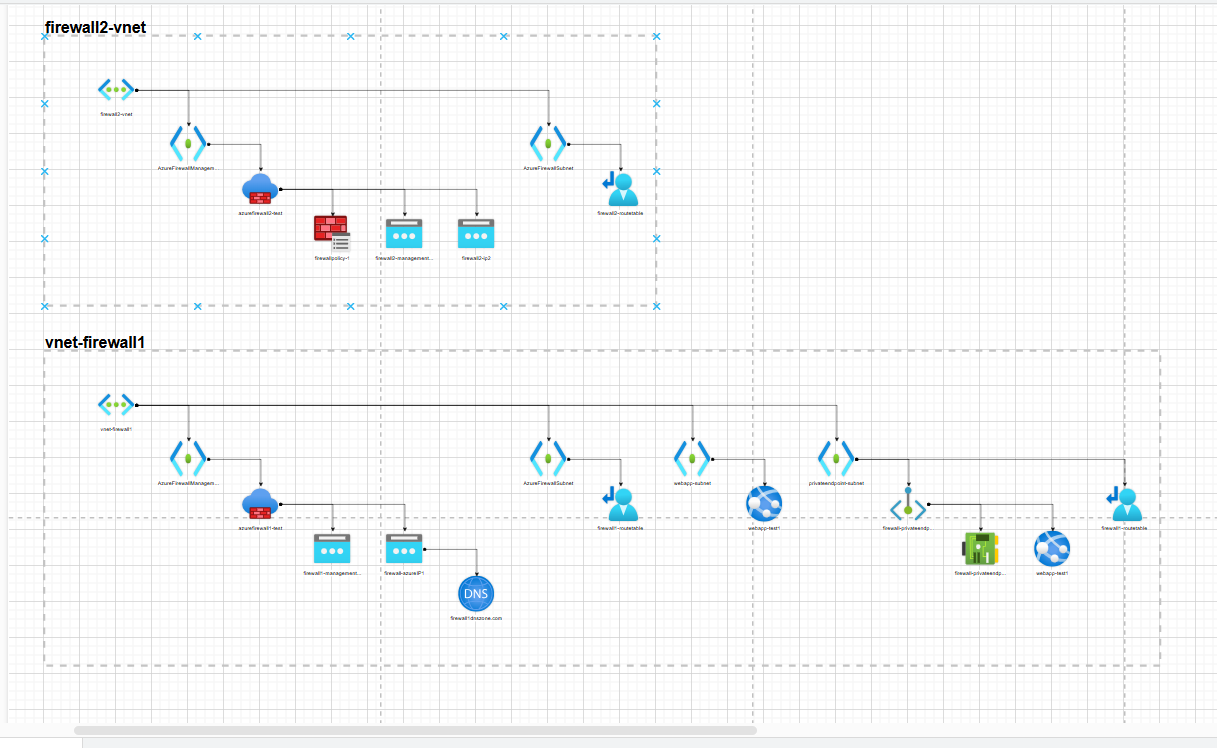
The Network topology diagram illustrates the structure of virtual networks and their interconnected resources, including:
- Azure Firewall and its policy, along with associated public IP addresses
- Route tables
- App Services
- Private endpoints with their network interface, App Services, and APIM service
- DNS zones linked to public IP addresses
- App Service Environments with their associated App Services
- Network interface cards with their network security group and virtual machines, along with disks
Hover over any resource in the diagram to view its Name, Type, Location, Group, and Tags.
Sample network topology diagram, showing Azure Firewall, DNS Zone, and App Services:
Steps
Use the following steps to generate a Network topology diagram. Navigate to Azure Documenter to get started.
- Click New configuration. The Configure your document wizard opens.
- In Step 1 — Basics, enter a configuration name. Under Choose document type, select Network topology diagram. Click Next.
- In Step 2 — Service principal, select the service principal and configure the subscription scope. Click Next.
- Complete Steps 3–6 (Branding, Publish settings, Schedule, Notifications) as required. Click Next after each step.
- In Step 7 — Review, confirm your configuration and click Finish.
Once generation is complete, a URL is created for the document, and you can download it using the Download link.
Example scenario
An Azure administrator needs a visual reference of the resources within a subscription's virtual network before a security review. They generate a Network topology diagram, download the resulting XML file, and open it in draw.io to review resource relationships and network boundaries.
Troubleshooting
-
Diagram shows no resources
Cause: no virtual network resources exist in the selected subscriptions, or the service principal lacks permission to read network resource data.
Fix: verify the subscription selection, confirm virtual network resources exist, and ensure the service principal has at least Reader access on all selected subscriptions. -
Diagram XML doesn't open correctly in draw.io
Cause: an outdated or incompatible draw.io version, or a corrupted download.
Fix: re-download the file and open it using a supported version of draw.io. -
Diagram is generated but resource details are incomplete
Cause: some resource types within the virtual network were not included in the scope of the selected service principal.
Fix: verify the service principal has Reader access on all resource groups within the selected subscriptions and regenerate.
FAQs
-
What format is the Network topology diagram generated in?
It is generated as an XML file, compatible with draw.io for visualization. -
What resource types are included in the diagram?
Azure Firewall, route tables, App Services, private endpoints, DNS zones, App Service Environments, network interface cards, virtual machines, and associated resources.